Exporting glass-processing machinery since 2002, with international project support from planning to installation and training.



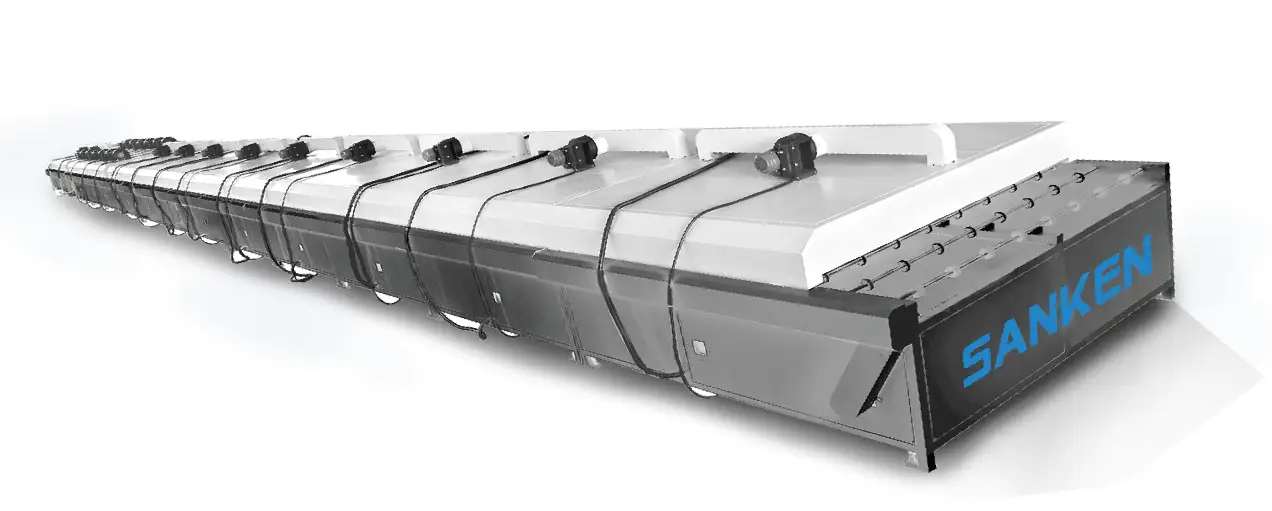
IR Tunnel Dryer for Glass Screen Printing – SKF-IR / 1017IR
-
SANKEN IR tunnel dryers dry printed glass through controlled heating and conveyor transport. Individually adjustable heating zones and variable conveyor speed allow the drying profile to be matched to the ink and production requirements.
- Six SKF-IR models with conveying widths from 600 to 2500 mm.
- SKF-IR dryer length: 23 m.
- Adjustable conveyor speed: 0–5 m/min.
- Maximum operating temperature: 220°C.
- Medium-wave IR heating and circulating hot air.
- Pneumatic cover lift for inspection and maintenance.
- Separate 17 m 1017IR configuration with PID temperature control.
IR Tunnel Drying After Glass Screen Printing
SANKEN IR tunnel dryers combine medium-wave infrared heating, circulating hot air and conveyor transport for drying printed glass. Operators adjust the conveyor speed and heating-zone temperatures to match the ink and production cycle.
The SKF-IR series includes six 23 m models with conveying widths from 600 to 2500 mm. A separate 1017IR configuration provides a 17 m drying arrangement with PID temperature control.
Heating and Conveyor Control
Medium-Wave IR Heating
Infrared heaters supply heat to the printed glass as it travels through the tunnel. Heating settings are selected around the ink supplier’s drying requirements.
Circulating Hot Air
Fans circulate heated air inside the furnace. An adjustable exhaust opening in the heating area supports process ventilation.
Individually Adjustable Heating Zones
Set heating zones individually, from ambient temperature up to a maximum of 220 °C. The zone settings establish the required drying profile along the conveyor.
Variable Conveyor Speed
The SKF-IR conveyor speed is adjustable from 0 to 5 m/min. Conveyor speed controls residence time in the heating and cooling sections.
PID Temperature Control
In the 1017IR configuration, PID control regulates heating output according to the difference between the measured temperature and the setpoint. Heating demand changes as the dryer warms up and the production load varies.
Structure and Maintenance
Insulated Chamber
The SKF-IR furnace interior uses 2 mm SUS304 stainless steel with heat-resistant insulation materials around the chamber.
Pneumatic Cover Lift
Cylinder-operated lifting opens the furnace cover for access to the interior, supporting inspection, cleaning and heater maintenance.
Cooling Section
Fans cool the printed glass after the heating stage. Cooling settings and unloading arrangements are planned around the glass and downstream process.
PLC and Touch Screen
The SKF-IR series uses PLC and touch-screen operation to manage conveyor and heating settings.
Working Sequence
Select the temperature profile and conveyor speed for the ink, glass and required drying result. Check the printed panel after drying before releasing the production batch.
SKF-IR Series – Technical Specifications
| Parameter | SKF-IR600 | SKF-IR800 | SKF-IR1000 |
|---|---|---|---|
| Max. Conveying Width | 600 mm | 800 mm | 1000 mm |
| Dryer Length | 23 m | 23 m | 23 m |
| Conveyor Speed | 0–5 m/min | 0–5 m/min | 0–5 m/min |
| Max. Temperature | 220 °C | 220 °C | 220 °C |
| Conveyor Height | 930 ± 20 mm | 930 ± 20 mm | 930 ± 20 mm |
| Air Supply Pressure | 0.6 MPa | 0.6 MPa | 0.6 MPa |
| Total Power | 71 kW | 94 kW | 116 kW |
| Machine Dimensions | 23000 × 1100 × 1550 mm | 23000 × 1300 × 1550 mm | 23000 × 1500 × 1550 mm |
| Machine Weight | 4000 kg | 4800 kg | 5800 kg |
| Parameter | SKF-IR1800 | SKF-IR2000 | SKF-IR2500 |
|---|---|---|---|
| Max. Conveying Width | 1800 mm | 2000 mm | 2500 mm |
| Dryer Length | 23 m | 23 m | 23 m |
| Conveyor Speed | 0–5 m/min | 0–5 m/min | 0–5 m/min |
| Max. Temperature | 220 °C | 220 °C | 220 °C |
| Conveyor Height | 930 ± 20 mm | 930 ± 20 mm | 930 ± 20 mm |
| Air Supply Pressure | 0.6 MPa | 0.6 MPa | 0.6 MPa |
| Total Power | 206 kW | 221 kW | 269 kW |
| Machine Dimensions | 23000 × 2300 × 1550 mm | 23000 × 2500 × 1550 mm | 23000 × 3000 × 1550 mm |
| Machine Weight | 9000 kg | 10000 kg | 15000 kg |
1017IR – 17 m PID-Controlled Configuration
The 1017IR configuration uses a mesh-belt conveyor with variable-frequency speed adjustment, PID temperature regulation, circulating air, a cooling section and a pneumatic cover lift.
Its heating assembly uses 36 IR tubes rated at 2 kW each, giving 72 kW of heating power. With 20 kW for motors and fans, the total rated power is 92 kW. This configuration is specified separately from the 23 m SKF-IR1000.
Send your glass size, ink requirements and factory plan so we can review the conveying width, heating length and utilities for the selected configuration.
Applications and Ink Selection
Use the dryer after glass screen printing for architectural panels, appliance glass, furniture glass and decorative printed products. Match the drying method to the ink formulation and the required downstream process.
For ceramic inks that require firing, arrange the subsequent glass heat-treatment stage separately from ink drying.
Integration with Screen Printing Equipment
Match conveyor width, transfer height, direction of travel and production speed to the upstream printer. Include cooling and unloading space when planning the complete workflow.
Frequently Asked Questions
Which SKF-IR models are available?
SKF-IR600, SKF-IR800, SKF-IR1000, SKF-IR1800, SKF-IR2000 and SKF-IR2500. The maximum conveying widths range from 600 to 2500 mm.
Are 1017IR and SKF-IR1000 the same configuration?
They are specified separately here. The SKF-IR1000 is a 23 m dryer with a 1000 mm maximum conveying width and 116 kW total power. The 1017IR is a 17 m configuration with 92 kW total rated power.
How is drying time adjusted?
Adjust conveyor speed to change the time the glass spends in the tunnel, then match the heating-zone settings to the ink requirements.
Does PID control guarantee a fixed percentage of energy savings?
PID control adjusts heating output to temperature demand. Actual electricity use depends on temperature settings, warm-up time, glass loading and operating conditions.
How is the furnace interior accessed?
The pneumatic cover lift opens the cover for inspection, cleaning and maintenance.
What is needed for model selection?
Send your largest glass dimensions, ink type and drying requirements, target output, factory layout, electrical supply and compressed-air availability.
Discuss Your Drying Requirements
Contact SANKEN for dryer selection, process configuration and installation planning.
SANKEN Glass Machinery is a Guangzhou-based manufacturer and international supplier of glass-processing machinery and complete production-line solutions.
Contact Us
Contact: Dalia Qiu
Tel: +86 15994813914
Landline: +86-20-82347228
Email: sales@sankenglass.com
WhatsApp: +86 15994813914
ADD: No.2, Xinghai Road, Lanhe, Nansha District, Guangzhou City, China. P.C 511480