Exporting glass-processing machinery since 2002, with international project support from planning to installation and training.

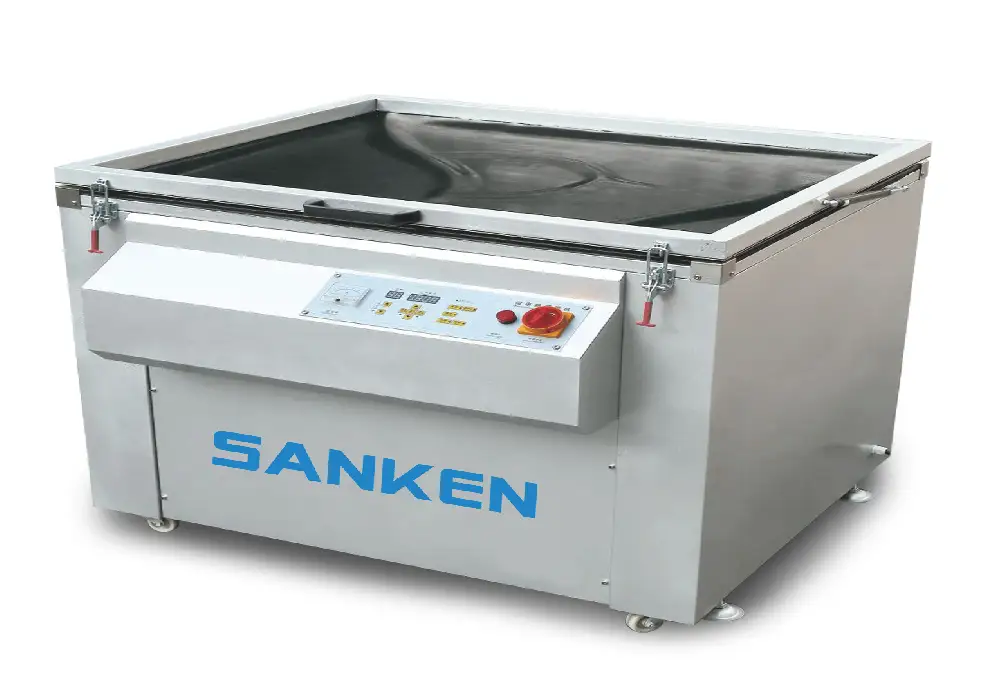
Screen Exposure Machine – SKP-E Series
The SANKEN SKP-E series prepares screen printing frames through controlled light exposure under vacuum contact. A microcomputer stores multiple exposure settings and coordinates vacuum draw-down, exposure and air release.
- Six models with maximum screen sizes from 1100 × 1700 to 2500 × 4800 mm.
- Horizontal configurations: SKP-0812E, 1525E, 1530E and 1925E.
- Vertical configurations: SKP-2030E and 2040E.
- Exposure-time range: 3–15 minutes.
- Stored exposure settings for different jobs.
- Controlled exposure light and an oil-free vacuum pump.
Screen Exposure for Glass Printing
The SANKEN SKP-E series exposes prepared screen printing frames using a controlled light source and vacuum contact. A microcomputer stores multiple exposure settings and coordinates vacuum draw-down, exposure and air release.
Six models cover maximum screen sizes from 1100 × 1700 mm to 2500 × 4800 mm. Horizontal configurations serve SKP-0812E through SKP-1925E, while SKP-2030E and SKP-2040E use a vertical arrangement for larger screens.
Equipment and Screen Preparation Views
Key Features
Stored Exposure Settings
The microcomputer stores multiple sets of exposure data for selection when preparing different jobs.
Automatic Vacuum, Exposure and Air Release
The control system completes vacuum draw-down, exposure and air release in an automatic sequence after setup.
Controlled Exposure Light
The exposure lamp and reflective housing distribute light over the screen. A light-control device regulates exposure to help manage changes associated with the lamp and power supply.
Oil-Free Vacuum Pump
An oil-free vacuum pump draws down the vacuum system to maintain contact during exposure.
Vacuum Rubber
The vacuum rubber is selected for tensile strength and resistance to ultraviolet exposure and aging.
Horizontal and Vertical Arrangements
Choose the screen handling arrangement around your frame dimensions and available workspace. Larger SKP-2030E and SKP-2040E models use vertical exposure.
Screen-Making Workflow
Prepare the coated screen and film before loading. Select the exposure setting for the screen preparation materials, then develop and inspect the screen after exposure. Developing and inspection take place in separate preparation stages.
Technical Specifications
| Parameter | SKP-0812E | SKP-1525E | SKP-1530E | SKP-1925E |
|---|---|---|---|---|
| Exposure Configuration | Horizontal | Horizontal | Horizontal | Horizontal |
| Max. Glass Size for Screen Selection | 800 × 1200 mm | 1500 × 2500 mm | 1500 × 3000 mm | 1900 × 2500 mm |
| Max. Screen Size | 1100 × 1700 mm | 1900 × 3200 mm | 2000 × 3700 mm | 2400 × 3200 mm |
| Exposure Time | 3–15 min | 3–15 min | 3–15 min | 3–15 min |
| Power | 4 kW | 8 kW | 8 kW | 8 kW |
| Machine Dimensions | 2000 × 1650 × 1400 mm | 3600 × 2350 × 1500 mm | 4200 × 2450 × 1500 mm | 3700 × 2850 × 1500 mm |
| Machine Weight | 800 kg | 1300 kg | 1500 kg | 1500 kg |
| Parameter | SKP-2030E | SKP-2040E |
|---|---|---|
| Exposure Configuration | Vertical | Vertical |
| Max. Glass Size for Screen Selection | 2000 × 3000 mm | 2000 × 4000 mm |
| Max. Screen Size | 2500 × 3800 mm | 2500 × 4800 mm |
| Exposure Time | 3–15 min | 3–15 min |
| Power | 8 kW | 8 kW |
| Machine Dimensions | 5200 × 2800 × 2900 mm | 6300 × 2800 × 2900 mm |
| Machine Weight | 1600 kg | 1700 kg |
The glass-size row helps select a screen for the intended printing format. The exposure machine processes prepared screen frames.
Supporting Screen Preparation Equipment
Screen Positioning Table
A positioning table supports film and screen alignment before exposure.
Screen Inspection Table
An inspection table is used to check the screen after developing.
Discuss positioning and inspection equipment separately when selecting the screen-making setup.
Applications
The SKP-E series supports screen preparation for glass printing artwork, lettering, borders and decorative patterns. Match the exposure setup to the screen frame, mesh, photosensitive coating and film.
Model Selection and Workshop Planning
Send the outside dimensions of your screen frames, the intended image area, mesh details, coating system and production requirements. Include the available workspace and electrical supply.
Allow access for loading frames, film alignment and maintenance. Plan developing and inspection stations alongside the exposure stage to organize the screen preparation workflow.
Frequently Asked Questions
Which models use horizontal exposure?
SKP-0812E, SKP-1525E, SKP-1530E and SKP-1925E.
Which models use vertical exposure?
SKP-2030E and SKP-2040E, for larger screen sizes.
Can exposure settings be saved?
Yes. The microcomputer stores multiple sets of exposure data for later selection.
What does the automatic sequence include?
Vacuum draw-down, exposure and air release after the screen and film are positioned.
Does exposure include developing?
Developing is a separate stage after exposure. Plan the developing and inspection equipment with the complete screen-making workflow.
How do I select the exposure time?
The exposure-time range is 3–15 minutes. Select the job setting around the screen preparation materials and verify it with an exposure test.
Are positioning and inspection tables included?
These are supporting equipment for separate preparation stages. Specify the required tables when requesting a quotation.
SANKEN Glass Machinery is a Guangzhou-based manufacturer and international supplier of glass-processing machinery and complete production-line solutions.
Contact Us
Contact: Dalia Qiu
Tel: +86 15994813914
Landline: +86-20-82347228
Email: sales@sankenglass.com
WhatsApp: +86 15994813914
ADD: No.2, Xinghai Road, Lanhe, Nansha District, Guangzhou City, China. P.C 511480