Exporting glass-processing machinery since 2002, with international project support from planning to installation and training.



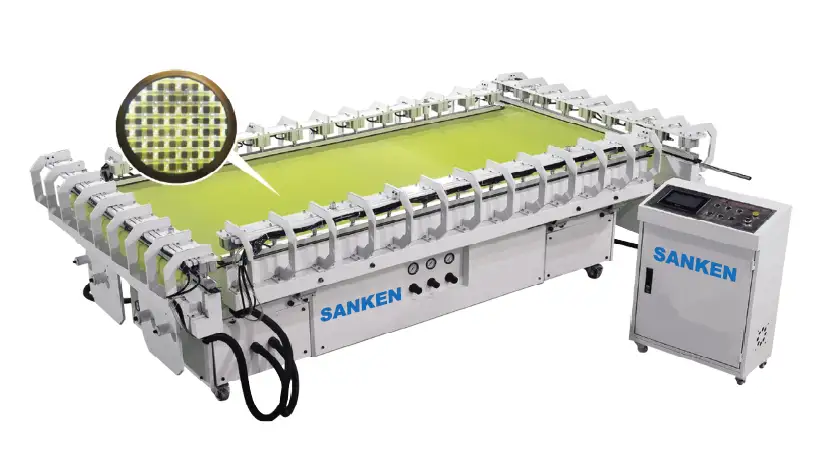
Automatic Screen Stretching Machine – SKP-S Series
The SANKEN SKP-S series stretches screen mesh over frames for glass screen printing. PLC and touch-screen control coordinate mesh clamping and tension adjustment, while pneumatic lifting brings the frame into contact with the tensioned mesh for adhesive bonding.
- Six models: SKP-0812S, 1525S, 1530S, 1925S, 2030S and 2040S.
- Maximum screen sizes from 1100 × 1700 to 2500 × 4800 mm.
- Automatic mesh clamping and tension adjustment.
- Pneumatic frame lifting before adhesive bonding.
- PLC and touch-screen operation.
- Total power: 3 kW.
- Air supply pressure: 0.5–0.7 MPa.
Automatic Screen Stretching for Glass Printing
The SANKEN SKP-S series stretches screen mesh over frames for glass screen printing. PLC and touch-screen control coordinate mesh clamping and tension adjustment, while pneumatic lifting brings the frame into contact with the tensioned mesh for adhesive bonding.
Six models provide maximum screen sizes from 1100 × 1700 mm to 2500 × 4800 mm. Select the machine around your screen frame dimensions and mesh preparation requirements.
Equipment Views
Mesh Clamping and Tensioning
PLC and Touch-Screen Operation
Operators manage the screen stretching process through the touch-screen interface. The PLC coordinates the machine’s clamping and stretching functions.
Automatic Mesh Clamping
Clamps hold the mesh during stretching and can move forwards, backwards, left and right to position and tension the material.
Automatic Tension Adjustment
The machine adjusts mesh tension during the stretching process. Select the tension setting to suit the mesh, screen frame and intended print application.
Pneumatic Frame Lifting
After the mesh reaches the required tension, the lifting system raises the frame towards the mesh. The frame stops close to the mesh for adhesive application and bonding.
Screen Frame Preparation
Place one or more frames beneath the mesh as the working area and frame arrangement allow. The tensioned mesh is bonded to the frame to prepare it for subsequent screen-making operations.
Working Sequence
Set up the mesh and frames before stretching. After tensioning and frame lifting, apply suitable adhesive and allow the bond to set before releasing the prepared frame.
Technical Specifications
| Parameter | SKP-0812S | SKP-1525S | SKP-1530S |
|---|---|---|---|
| Max. Glass Size for Screen Selection | 800 × 1200 mm | 1500 × 2500 mm | 1500 × 3000 mm |
| Max. Screen Size | 1100 × 1700 mm | 1900 × 3200 mm | 2000 × 3700 mm |
| Tension Accuracy | ±0.5 N | ±0.5 N | ±0.5 N |
| Max. Pulling Force | 60 N | 60 N | 60 N |
| Air Supply Pressure | 0.5–0.7 MPa | 0.5–0.7 MPa | 0.5–0.7 MPa |
| Total Power | 3 kW | 3 kW | 3 kW |
| Machine Dimensions | 2500 × 1500 × 950 mm | 4000 × 2100 × 950 mm | 4500 × 2200 × 950 mm |
| Machine Weight | 1000 kg | 1500 kg | 1700 kg |
| Parameter | SKP-1925S | SKP-2030S | SKP-2040S |
|---|---|---|---|
| Max. Glass Size for Screen Selection | 1900 × 2500 mm | 2000 × 3000 mm | 2000 × 4000 mm |
| Max. Screen Size | 2400 × 3200 mm | 2500 × 3800 mm | 2500 × 4800 mm |
| Tension Accuracy | ±0.5 N | ±0.5 N | ±0.5 N |
| Max. Pulling Force | 60 N | 60 N | 60 N |
| Air Supply Pressure | 0.5–0.7 MPa | 0.5–0.7 MPa | 0.5–0.7 MPa |
| Total Power | 3 kW | 3 kW | 3 kW |
| Machine Dimensions | 4000 × 2600 × 950 mm | 4500 × 2700 × 950 mm | 5500 × 2700 × 950 mm |
| Machine Weight | 1700 kg | 1800 kg | 2000 kg |
The glass-size row helps match screen preparation to the intended printing format. This machine processes screen mesh and frames.
Applications in Screen Preparation
Use the SKP-S series to prepare screen mesh on frames for glass printing artwork, lettering, borders and decorative designs. The selected screen size should match the printer and required image area.
Screen coating, exposure and developing are subsequent preparation stages. Plan the workflow around the mesh, emulsion, artwork and ink system used in production.
Installation and Model Selection
Send your frame outside dimensions, mesh type, target tension and the number of frames to be handled per cycle. Include the screen printer model and intended glass format when selecting the stretching area.
All six models have 3 kW total power and require a 0.5–0.7 MPa compressed-air supply. Allow space around the machine for mesh handling, frame placement, adhesive work and maintenance.
Frequently Asked Questions
What does the machine stretch?
It stretches screen mesh over frames for screen printing. Glass printing is performed on a separate screen printing machine.
Which models are included?
SKP-0812S, SKP-1525S, SKP-1530S, SKP-1925S, SKP-2030S and SKP-2040S.
Can the machine handle more than one frame?
One or more frames can be placed beneath the mesh, depending on their dimensions and the available working area. Send the proposed frame arrangement for review.
Is adhesive application part of the process?
Yes. After tensioning and frame lifting, adhesive bonds the frame and mesh. The workflow includes adhesive application; an automatic glue dispenser is not specified here.
How do I choose the model?
Start with the frame dimensions and maximum screen size, then review the mesh, tension requirements and frame arrangement with us.
How does this differ from an SKP printing machine?
SKP-S models on this page prepare the mesh and frames. The SKP screen printing machines transfer ink through a prepared screen onto glass.
SANKEN Glass Machinery is a Guangzhou-based manufacturer and international supplier of glass-processing machinery and complete production-line solutions.
Contact Us
Contact: Dalia Qiu
Tel: +86 15994813914
Landline: +86-20-82347228
Email: sales@sankenglass.com
WhatsApp: +86 15994813914
ADD: No.2, Xinghai Road, Lanhe, Nansha District, Guangzhou City, China. P.C 511480