Exporting glass-processing machinery since 2002, with international project support from planning to installation and training.



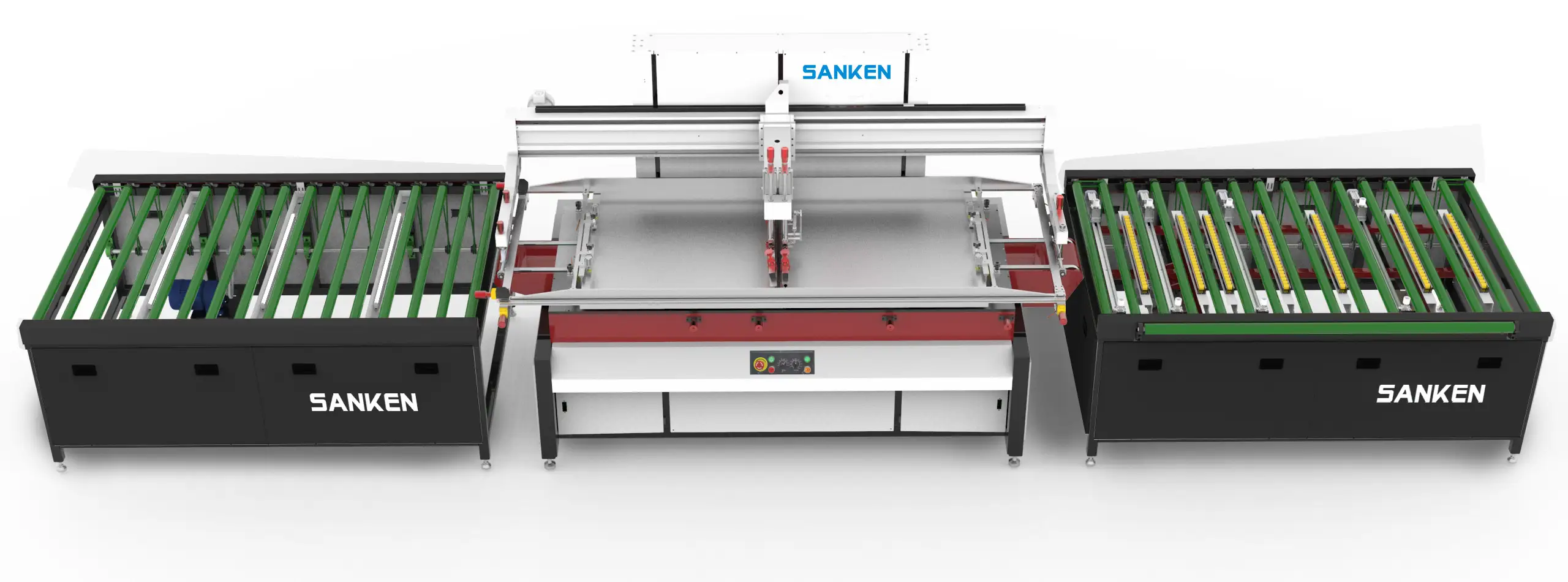
Automatic Glass Screen Printing Line – SKPL Series
-
The SANKEN SKPL series integrates flat glass screen printing with servo-controlled printing and ink-return strokes, synchronized glass conveying and IR tunnel drying.
- Seven models with maximum glass sizes from 1000 × 1500 to 2500 × 5100 mm.
- Glass thickness range: 2–19 mm.
- Repeatability: ±0.1 mm.
- Mitsubishi PLC and touch-screen operation.
- Automatic arraying on SKPL-1015 through SKPL-2040.
Automatic Glass Screen Printing
The SANKEN SKPL series connects glass pre-positioning, screen printing, inspection, automatic arraying and IR drying in one production line. Servo motors control the printing and ink-return strokes, while synchronized conveyor belts transfer glass between production sections.
Seven models cover maximum glass sizes from 1000 × 1500 mm to 2500 × 5100 mm. All models process glass thicknesses of 2–19 mm, with repeatability of ±0.1 mm.
Production Sections
Automatic Pre-Positioning
The incoming glass is aligned in the automatic pre-positioning section before printing. Positioning establishes the panel location for the printing cycle.
Automatic Screen Printing
Ink is transferred through the prepared screen onto the glass. Servo motors control the printing squeegee and ink-return strokes.
Inspection Section
The inspection section provides a stage for checking the printed glass before it moves to arraying and drying.
Automatic Arraying
Printed panels are arranged for transfer into the drying section. Automatic arraying is included on SKPL-1015 through SKPL-2040. SKPL-2551 uses a configuration without the standard automatic arraying section.
IR Tunnel Drying
A 23 m IR tunnel dries the printed ink after arraying. Select the drying settings around the ink and downstream production requirements.
Key Features
Servo-Controlled Print and Ink Return
Servo-driven strokes control the printing squeegee and ink return. Repeatability is ±0.1 mm across the series.
Four-Pillar Structure
A four-pillar frame supports vertical movement of the screen assembly during the printing cycle.
Mitsubishi PLC and Touch Screen
Operators manage the line through a touch-screen interface and Mitsubishi PLC. Program protection functions help manage operating limits and reduce incorrect commands.
Synchronized Conveyor Belts
Synchronized anti-sliding belts support controlled glass transport between production sections.
Working Sequence
Prepare the screen, ink and clean glass before production. Set the positioning, printing and dryer parameters for the job, then check the print before releasing the batch to the next process.
Technical Specifications
| Parameter | SKPL-1015 | SKPL-1326 | SKPL-1530 | SKPL-1925 |
|---|---|---|---|---|
| Max. Glass Size | 1000 × 1500 mm | 1300 × 2600 mm | 1500 × 3000 mm | 1900 × 2500 mm |
| Min. Glass Size | 400 × 500 mm | 500 × 700 mm | 600 × 700 mm | 600 × 700 mm |
| Max. Screen Frame Size | 1400 × 2100 mm | 1800 × 3300 mm | 2000 × 3700 mm | 2400 × 3200 mm |
| Glass Thickness | 2–19 mm | 2–19 mm | 2–19 mm | 2–19 mm |
| Printing Speed | ≥ 2 pcs/min | ≥ 2 pcs/min | ≥ 2 pcs/min | ≥ 2 pcs/min |
| Max. Arraying Width | 1800 mm | 2000 mm | 2000 mm | 2000 mm |
| IR Tunnel Dryer Size | 23000 × 1800 mm | 23000 × 1800 mm | 23000 × 2000 mm | 23000 × 2000 mm |
| Repeatability | ±0.1 mm | ±0.1 mm | ±0.1 mm | ±0.1 mm |
| Air Supply Pressure | 0.6 MPa | 0.6 MPa | 0.6 MPa | 0.6 MPa |
| Total Electrical Power | 216 kW | 218 kW | 234 kW | 234 kW |
| Machine Dimensions | 32100 × 2300 × 1800 mm | 35300 × 2300 × 1800 mm | 36500 × 2500 × 1800 mm | 35000 × 2700 × 1800 mm |
| Machine Weight | 12100 kg | 13100 kg | 14620 kg | 15120 kg |
| Parameter | SKPL-2030 | SKPL-2040 | SKPL-2551 |
|---|---|---|---|
| Max. Glass Size | 2000 × 3000 mm | 2000 × 4000 mm | 2500 × 5100 mm |
| Min. Glass Size | 700 × 800 mm | 700 × 900 mm | 700 × 900 mm |
| Max. Screen Frame Size | 2500 × 3800 mm | 2500 × 4800 mm | 3000 × 5800 mm |
| Glass Thickness | 2–19 mm | 2–19 mm | 2–19 mm |
| Printing Speed | ≥ 2 pcs/min | ≥ 2 pcs/min | ≥ 2 pcs/min |
| Max. Arraying Width | 2000 mm | 2000 mm | — |
| IR Tunnel Dryer Size | 23000 × 2000 mm | 23000 × 2000 mm | 23000 × 2500 mm |
| Repeatability | ±0.1 mm | ±0.1 mm | ±0.1 mm |
| Air Supply Pressure | 0.6 MPa | 0.6 MPa | 0.6 MPa |
| Total Electrical Power | 235 kW | 237 kW | 300 kW |
| Machine Dimensions | 36600 × 2800 × 1800 mm | 39600 × 2800 × 1800 mm | 40300 × 3300 × 1800 mm |
| Machine Weight | 15320 kg | 16320 kg | 23000 kg |
Glass Printing Applications
The SKPL series supports flat glass printing for architectural, office, kitchen, furniture, appliance and decorative glass products. Automotive glass printing projects can also be reviewed against the panel geometry and process requirements.
Share the glass dimensions, artwork, ink type and required finish so we can match the model and production configuration to your product.
Equipment Views
Ink Drying and Downstream Processing
The IR tunnel dries the printed ink as part of the printing line. Match dryer settings to the ink supplier’s requirements and the production sequence.
For ceramic inks that require firing, plan the subsequent glass heat-treatment stage separately. The IR drying section does not replace the firing process.
Factory Planning
Plan the line around its full length, glass loading and unloading areas, screen access and maintenance clearance. Select the line dimensions from the model tables and allow additional access for loading, unloading and maintenance.
All seven models require a 0.6 MPa air supply. Total electrical power ranges from 216 to 300 kW, depending on model. Include the dryer and utilities when reviewing installation requirements.
Contact SANKEN with your factory plan and glass printing requirements.
Frequently Asked Questions
Which models are included?
The SKPL series includes SKPL-1015, SKPL-1326, SKPL-1530, SKPL-1925, SKPL-2030, SKPL-2040 and SKPL-2551.
Which sections are included in the standard line?
SKPL-1015 through SKPL-2040 include automatic pre-positioning, screen printing, inspection, automatic arraying and IR drying. SKPL-2551 does not include the standard automatic arraying section.
Does the inspection section automatically detect every print defect?
Discuss the required inspection method and detection functions with us when selecting the line configuration.
Does the IR tunnel fire ceramic ink?
The tunnel is the ink-drying stage. Ceramic inks requiring firing need a separate downstream heat-treatment process.
What information is needed for model selection?
Send your glass size range, thickness, artwork, ink specifications, target output, power supply and available factory space.
SANKEN Glass Machinery is a Guangzhou-based manufacturer and international supplier of glass-processing machinery and complete production-line solutions.
Contact Us
Contact: Dalia Qiu
Tel: +86 15994813914
Landline: +86-20-82347228
Email: sales@sankenglass.com
WhatsApp: +86 15994813914
ADD: No.2, Xinghai Road, Lanhe, Nansha District, Guangzhou City, China. P.C 511480