Exporting glass-processing machinery since 2002, with international project support from planning to installation and training.



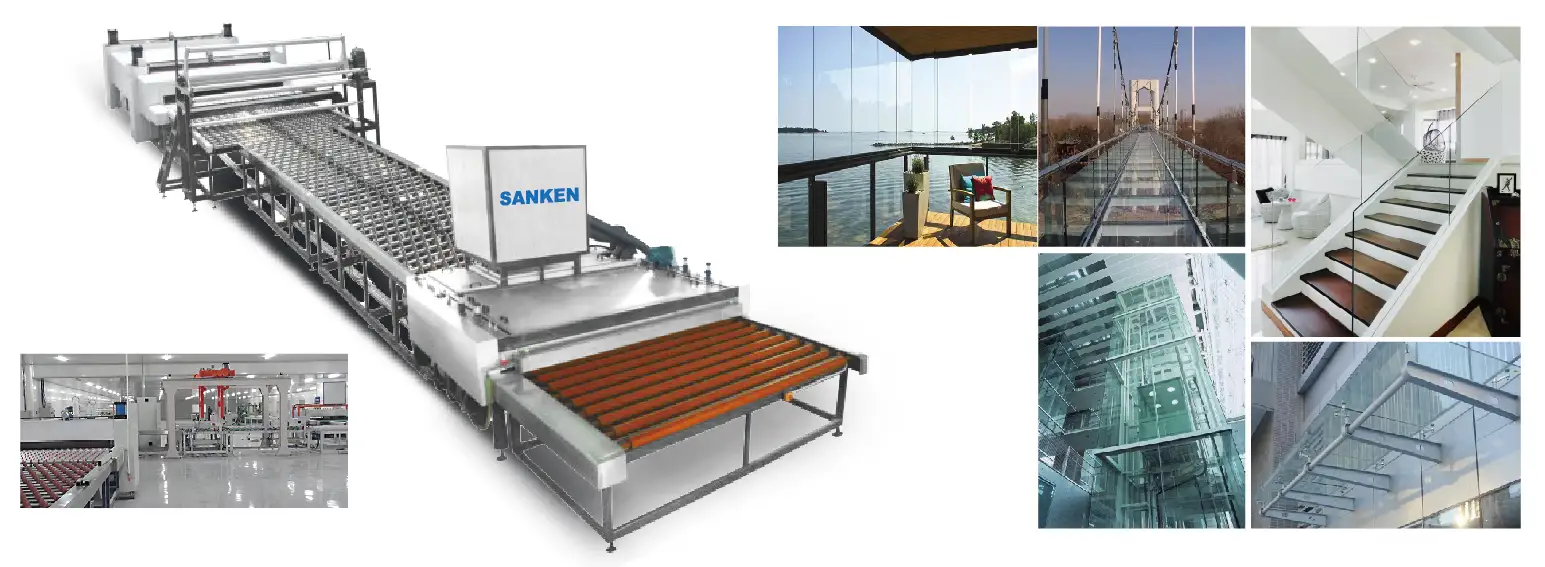
Semi-Automatic PVB Laminated Glass Production Line – SKPL-S Series
The SANKEN SKPL-S series combines automatic processing sections with operator-assisted glass and PVB assembly. A movable suction transfer hanger assists glass placement, while operators unwind and position the film. Siemens PLC control coordinates washing, positioning, conveying and pre-lamination pressing before separate autoclave processing.
- Six models: SKPL-2030S, SKPL-2040S, SKPL-2540S, SKPL-2560S, SKPL-3060S and SKPL-3360S.
- Maximum glass sizes: From 2000 × 3000 mm to 3300 × 6000 mm, depending on the model.
- Minimum glass size: 300 × 420 mm.
- Processing thickness: 6–80 mm.
- Conveying speed: 1–5 m/min.
- Control system: Siemens PLC and touch screen.
- Glass handling: Movable suction transfer hanger for assisted placement.
- Film handling: Manual PVB unwinding and operator-assisted assembly.
- Pre-lamination: Automatic conveying and pressing, followed by separate autoclave processing.
Semi-Automatic PVB Laminated Glass Production Line
SANKEN SKPL-S series combines automatic glass washing, positioning, conveying and pre-lamination pressing with a movable suction transfer hanger, manual PVB film unwinding and operator-assisted glass assembly. Siemens PLC and touch-screen control coordinate the line, with frequency-controlled conveying for production adjustment.
Six models cover maximum glass sizes from 2000 × 3000 mm to 3300 × 6000 mm. All six process a thickness range of 6–80 mm and a minimum glass size of 300 × 420 mm. Select the model according to the required laminate dimensions, output, handling arrangement and available factory space.
Production Line and Application Views
Main Line Components
1. Automatic Glass Washing Machine
The washer prepares the glass surfaces before interlayer assembly. Washed glass transfers to the positioning and conveying section for the next operation.
2. Automatic Positioning and Transmission Equipment
The positioning and transmission section brings the glass to the assembly area. Frequency-controlled movement allows conveying speed to be adjusted within 1–5 m/min.
3. Movable Suction Transfer Hanger
A movable suction transfer hanger assists glass transfer during assembly. Operators use the assisted handling arrangement to place the glass layers as required by the laminate structure.
4. Manual PVB Film Unwinding Equipment
The manual unwinding station supplies PVB film for the glass-and-interlayer stack. Operators handle the film and complete the positioning and assembly work at the lamination station.
5. Automatic Conveying Table
The conveying table moves the assembled laminate toward the pre-lamination section, coordinating material transfer with the rest of the line.
6. Automatic Pre-Lamination Pressing Machine
The pre-lamination pressing section processes the assembled glass-and-PVB stack before transfer for final autoclave bonding.
Control and Production Arrangement
Siemens PLC and Touch-Screen Operation
Centralized PLC and touch-screen control coordinate the automatic sections. The line can run synchronously, with frequency speed control for conveying adjustment.
Automatic Processing with Manual Assembly
Automatic washing, positioning, conveying and pre-lamination pressing are combined with manual PVB unwinding and operator-assisted assembly. This arrangement suits factories that plan to retain hands-on control of the interlayer and glass assembly stages.
Six Glass Formats
The model range covers 2000 × 3000 mm, 2000 × 4000 mm, 2500 × 4000 mm, 2500 × 6000 mm, 3000 × 6000 mm and 3300 × 6000 mm maximum glass sizes.
Interlayer and Glass Build-Up
Configure the line for the required PVB film, glass dimensions and laminate structure. Match the selected build-up to the processing thickness range and the downstream autoclave arrangement.
Technical Specifications
| Parameter | SKPL-2030S | SKPL-2040S | SKPL-2540S |
|---|---|---|---|
| Max. Glass Size | 2000 × 3000 mm | 2000 × 4000 mm | 2500 × 4000 mm |
| Min. Glass Size | 300 × 420 mm | 300 × 420 mm | 300 × 420 mm |
| Processing Thickness | 6–80 mm | 6–80 mm | 6–80 mm |
| Production Efficiency | 30–45 pieces/hour | 30–45 pieces/hour | 25–40 pieces/hour |
| Area Capacity | Approx. 180 m²/hour | Approx. 200 m²/hour | Approx. 250 m²/hour |
| Conveying Speed | 1–5 m/min | 1–5 m/min | 1–5 m/min |
| Air Pressure | 0.6–0.8 MPa | 0.6–0.8 MPa | 0.6–0.8 MPa |
| Line Power | 123 kW | 137 kW | 163 kW |
| Occupied Space (L × W × H) | 35 × 6 × 4 m | 40 × 6 × 4 m | 40 × 6.5 × 4 m |
| Line Weight | 13.5 tonnes | 14.5 tonnes | 16.5 tonnes |
| Parameter | SKPL-2560S | SKPL-3060S | SKPL-3360S |
|---|---|---|---|
| Max. Glass Size | 2500 × 6000 mm | 3000 × 6000 mm | 3300 × 6000 mm |
| Min. Glass Size | 300 × 420 mm | 300 × 420 mm | 300 × 420 mm |
| Processing Thickness | 6–80 mm | 6–80 mm | 6–80 mm |
| Production Efficiency | 15–30 pieces/hour | 15–20 pieces/hour | 15–20 pieces/hour |
| Area Capacity | Approx. 260 m²/hour | Approx. 280 m²/hour | Approx. 300 m²/hour |
| Conveying Speed | 1–5 m/min | 1–5 m/min | 1–5 m/min |
| Air Pressure | 0.6–0.8 MPa | 0.6–0.8 MPa | 0.6–0.8 MPa |
| Line Power | 192 kW | 251 kW | 279 kW |
| Occupied Space (L × W × H) | 50 × 6.5 × 4 m | 50 × 7 × 4 m | 50 × 7.3 × 4 m |
| Line Weight | 18.2 tonnes | 24.5 tonnes | 26.8 tonnes |
Production efficiency and area capacity depend on glass size, laminate structure, manual assembly time, interlayer handling and operating conditions. Conveying speed describes transport movement and does not represent completed laminates per minute.
The occupied-space figures cover the line arrangement. Plan additional space for glass and film storage, the lamination room, operating aisles, maintenance and autoclave handling. Confirm the equipment list and utilities for the complete production arrangement.
Semi-Automatic Laminating Process
Glass Washing & Drying → Positioning & Conveying → Assisted Glass Transfer → Manual PVB Film Handling & Assembly → Automatic Conveying → Pre-Lamination Pressing → Autoclave Processing
Prepare the Glass
Select the glass panes and PVB film for the required laminate. Feed the glass to the washer, then transfer the cleaned panes to the assembly area.
Assemble the Glass and Film
Use the movable suction transfer hanger for assisted glass placement. Operators unwind and position the PVB film and complete the layer alignment at the assembly station.
Pre-Laminate the Assembled Stack
The conveying table transfers the assembled laminate into the automatic pre-lamination pressing section.
Complete Autoclave Bonding
Transfer the pre-laminated glass to a separate autoclave for final heat-and-pressure bonding. Match autoclave working size, loading capacity and process requirements to the glass build-up and line output.
Factory Layout and Autoclave Connection
Arrange the washer, lamination room, assembly station, pre-lamination section and autoclave transfer route around a continuous glass flow. Leave suitable working space for the suction hanger, film handling and manual assembly operations.
This PVB lamination arrangement combines glass washing, the lamination room, pre-lamination pressing, transfer rails and an autoclave. We adapt the equipment positions to the selected line size, building dimensions and material handling requirements.
Across the six models, line space ranges from 35 × 6 × 4 m to 50 × 7.3 × 4 m. Provide compressed air at 0.6–0.8 MPa and an electrical supply matched to the selected line power. Plan the autoclave and its supporting utilities separately as part of the complete factory arrangement.
Semi-Automatic or Full-Automatic Configuration
The SKPL-S series retains manual film unwinding and operator-assisted positioning and assembly. The SKPL-A full-automatic series adds automatic glass loading, automatic suction transfer and motorized film unwinding within its handling arrangement.
Choose the configuration according to glass sizes, production targets, staffing and the automation level required at the assembly stage.
Explore the SKPL-A full-automatic PVB laminated glass production line.
Laminated Glass Applications
The line prepares PVB laminated glass for architectural glazing applications such as windows, facades, railings and roof glazing. The glass structure, interlayer and final processing determine the properties of the finished laminate.
Frequently Asked Questions
Which models are available?
The semi-automatic range includes SKPL-2030S, SKPL-2040S, SKPL-2540S, SKPL-2560S, SKPL-3060S and SKPL-3360S.
Which operations are manual?
Operators handle manual PVB film unwinding and glass-and-film positioning and assembly, with support from a movable suction transfer hanger. Washing, positioning equipment, conveying and pre-lamination pressing use automatic sections.
What glass sizes and thicknesses can the line process?
Maximum sizes vary by model from 2000 × 3000 mm to 3300 × 6000 mm. All models have a minimum glass size of 300 × 420 mm and a processing thickness range of 6–80 mm.
What production capacity does the series cover?
Production efficiency ranges from 15–45 pieces/hour across the models, with approximate area capacities of 180–300 m²/hour. Refer to the specification table for each model; actual output depends on panel size, laminate structure and assembly conditions.
Does the line require an autoclave?
For the PVB process described here, pre-lamination is followed by final bonding in a separate autoclave. Configure the autoclave and transfer equipment around the required laminate size and production capacity.
How do I select the model?
Start with the largest required glass size, then review the laminate build-up, target output, manual handling arrangement, workshop dimensions and autoclave capacity.
What information should I send for a quotation?
Send maximum and minimum glass sizes, glass-and-interlayer build-up, PVB film specifications, required output, factory drawing, available utilities and any existing autoclave details.
Plan Your Semi-Automatic Laminating Line
SANKEN has been exporting glass-processing machinery since 2002. Send us your laminate specifications and factory layout to discuss the SKPL-S model, assembly arrangement and autoclave connection.
SANKEN Glass Machinery is a Guangzhou-based manufacturer and international supplier of glass-processing machinery and complete production-line solutions.
Contact Us
Contact: Dalia Qiu
Tel: +86 15994813914
Landline: +86-20-82347228
Email: sales@sankenglass.com
WhatsApp: +86 15994813914
ADD: No.2, Xinghai Road, Lanhe, Nansha District, Guangzhou City, China. P.C 511480