Exporting glass-processing machinery since 2002, with international project support from planning to installation and training.



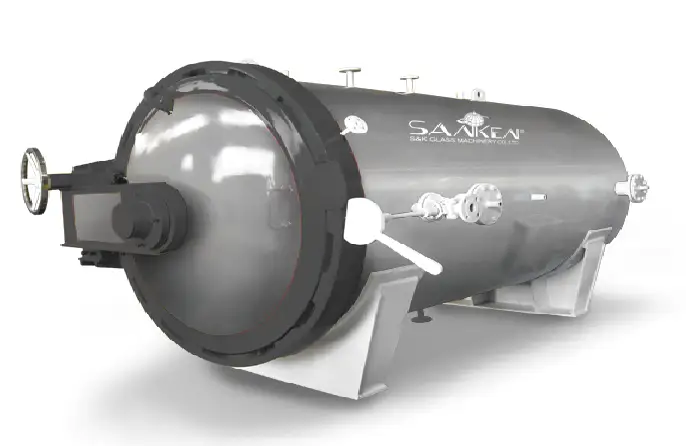
Laminated Glass Autoclave – SKA Series
The SANKEN SKA series completes the autoclave bonding stage of PVB laminated glass production. Siemens PLC control coordinates the processing cycle, while medium-wave infrared heating supplies process heat. Four sizes allow the autoclave to be matched with glass dimensions, batch arrangements and the upstream laminating line.
- Models: SKA-2050, SKA-2550, SKA-2860 and SKA-3380.
- Maximum glass sizes: 1600 × 5000 mm to 3050 × 8000 mm, depending on the model.
- Control system: Siemens PLC and 15-inch touch screen.
- Heating: Medium-wave infrared heating.
- Operating pressure: 1.25 MPa.
- Maximum pressure: 1.5 MPa.
- Operating temperature: 135°C.
- Cycle time: 4–6 hours, depending on the laminate and processing conditions.
- Control functions: Pressure-monitored door interlock, closed-door start condition and automatic exhaust response to overpressure or overtemperature.
- Supporting equipment: Optional air compressor and air dryer.
Autoclave for PVB Laminated Glass
SANKEN SKA series autoclaves provide the heat-and-pressure processing stage for PVB laminated glass after assembly and pre-lamination. The autoclave bonds the glass and interlayer stack as part of an architectural or automotive laminated glass production process.
The series includes SKA-2050, SKA-2550, SKA-2860 and SKA-3380. Maximum glass processing sizes range from 1600 × 5000 mm to 3050 × 8000 mm, with Siemens PLC control, a 15-inch touch screen and medium-wave infrared heating.
Autoclave and Equipment Views
Main Features
Siemens PLC and 15-Inch Touch Screen
The PLC and touch-screen interface control the automatic processing cycle. Operators configure the processing conditions for the selected glass-and-PVB build-up.
Medium-Wave Infrared Heating
The heating system uses medium-wave infrared heating for the autoclave process. Coordinate the heating conditions with the laminate structure, loading arrangement and interlayer requirements.
Pressure-Monitored Door Interlock
The door interlock monitors internal pressure and inhibits door-motor operation when pressure is present. A closed-door condition is required before the processing cycle can start.
Overpressure and Overtemperature Response
The control system provides an automatic exhaust response to overpressure or overtemperature conditions.
Door Sealing Arrangement
The autoclave door incorporates a sealing arrangement for pressurized processing. Door closure and the interlock are coordinated with the process controls.
Connection with PVB Laminating Lines
The autoclave works downstream of glass assembly and pre-lamination pressing. Select its working size and batch arrangement to match the output and dimensions of the upstream laminating line.
Technical Specifications
| Parameter | SKA-2050 | SKA-2550 | SKA-2860 | SKA-3380 |
|---|---|---|---|---|
| Max. Glass Processing Size | 1600 × 5000 mm | 2100 × 5000 mm | 2440 × 6000 mm | 3050 × 8000 mm |
| Inner Diameter | 2000 mm | 2500 mm | 2850 mm | 3500 mm |
| Rail Spacing | 700 mm | 900 mm | 900 mm | 900 mm |
| Inner Width | 1200 mm | 1600 mm | 1800 mm | 2000 mm |
| Maximum Pressure | 1.5 MPa | 1.5 MPa | 1.5 MPa | 1.5 MPa |
| Operating Pressure | 1.25 MPa | 1.25 MPa | 1.25 MPa | 1.25 MPa |
| Operating Temperature | 135 °C | 135 °C | 135 °C | 135 °C |
| Cycle Time | 4–6 hours | 4–6 hours | 4–6 hours | 4–6 hours |
| Cooling Water Volume | 15 m³ | 20 m³ | 30 m³ | 50 m³ |
| Recommended Compressor Power | 22 kW | 37 kW | 55 kW | 90 kW |
| Autoclave Power | 55 kW | 86 kW | 141 kW | 188 kW |
| Machine Dimensions (L × W × H) | 6400 × 2450 × 2300 mm | 6500 × 2850 × 2900 mm | 7800 × 3250 × 3350 mm | 10200 × 3750 × 3700 mm |
| Machine Weight | 7 tonnes | 13 tonnes | 18 tonnes | 24 tonnes |
Operating pressure and maximum pressure are separate specifications. The 4–6 hour cycle time is a cycle reference; production scheduling depends on the laminate structure, loading arrangement and selected processing cycle.
Cooling water figures are volumes expressed in m³. Autoclave power and recommended compressor power are listed separately. Confirm the complete utility requirements and equipment configuration for the installation.
Position in the Laminated Glass Process
Glass Washing → Glass and PVB Assembly → Pre-Lamination Pressing → Batch Transfer → Autoclave Bonding → Finished-Laminate Inspection
Upstream Assembly and Pre-Lamination
Prepare the glass-and-PVB stack on the laminating line and complete the pre-lamination stage before transferring it to the autoclave handling system.
Autoclave Bonding
The autoclave applies the selected heat-and-pressure cycle to the prepared laminate. Match processing conditions to the interlayer, glass build-up and batch loading arrangement.
Downstream Handling
Coordinate unloading, cooling and inspection with the factory process and equipment instructions. Finished laminate properties depend on the complete glass structure, interlayer and processing quality.
Selecting the Autoclave Size
Glass Dimensions and Loading Arrangement
Select the model by the largest glass panel and the intended batch arrangement. Check the maximum processing size together with vessel diameter, internal clearances, rail spacing and transfer equipment.
Batch Capacity and Line Output
Balance the autoclave batch plan and cycle time with the upstream laminating line. Consider the mix of glass sizes and structures when planning the loading schedule.
Transfer Rails and Handling Space
Coordinate the autoclave rail spacing with loading equipment and the transfer route. Allow space for door movement, loading, unloading and maintenance access.
Supporting Utilities
The recommended compressor power ranges from 22 kW to 90 kW across the models. Air compressors and air dryers can be selected as optional supporting equipment. Plan the cooling water system and electrical supply for the complete arrangement.
PVB Production Area Layout
This arrangement connects the PVB laminating line with pre-lamination pressing, transfer rails and an autoclave. We adapt the layout to the selected SKA model, glass dimensions, loading arrangement and available workshop space.
Keep the autoclave transfer route coordinated with the pre-lamination discharge area. Plan separate positions for supporting air equipment, cooling water connections and electrical services.
Frequently Asked Questions
Which SKA models are available?
The series includes SKA-2050, SKA-2550, SKA-2860 and SKA-3380, covering maximum glass processing sizes of 1600 × 5000 mm, 2100 × 5000 mm, 2440 × 6000 mm and 3050 × 8000 mm respectively.
What is the autoclave used for?
It provides final heat-and-pressure bonding for prepared PVB laminated glass after assembly and pre-lamination.
What control system is used?
The autoclave uses Siemens PLC control and a 15-inch touch screen.
What are the pressure and temperature specifications?
All four models have an operating pressure of 1.25 MPa, a maximum pressure specification of 1.5 MPa and an operating temperature of 135 °C. Confirm the processing cycle for the selected laminate and interlayer.
How long is the processing cycle?
The cycle reference is 4–6 hours. The production schedule depends on the laminate structure, batch arrangement and selected processing conditions.
Are the compressor and air dryer included?
They are optional supporting equipment. Confirm the supply scope and required compressor capacity when configuring the project.
Can the autoclave connect with full-automatic and semi-automatic laminating lines?
Yes. Match the working size, transfer rails and batch plan to the selected laminating line and glass formats.
What information is needed for model selection?
Send the largest glass dimensions, laminate build-ups, interlayer specifications, required batch output, upstream line details, factory layout and available utilities.
Plan Your Laminated Glass Autoclave
SANKEN has been exporting glass-processing machinery since 2002. Send us your laminate specifications and line arrangement to discuss the autoclave model, transfer system and supporting equipment.
SANKEN Glass Machinery is a Guangzhou-based manufacturer and international supplier of glass-processing machinery and complete production-line solutions.
Contact Us
Contact: Dalia Qiu
Tel: +86 15994813914
Landline: +86-20-82347228
Email: sales@sankenglass.com
WhatsApp: +86 15994813914
ADD: No.2, Xinghai Road, Lanhe, Nansha District, Guangzhou City, China. P.C 511480