Exporting glass-processing machinery since 2002, with international project support from planning to installation and training.



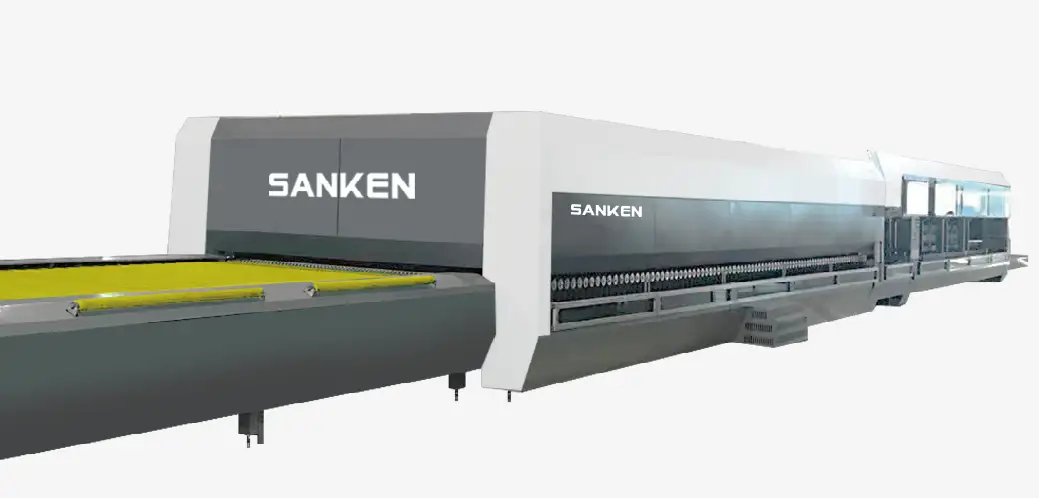
Automotive Glass Bending & Tempering Furnace – SKAL-BT Series
The SANKEN SKAL-BT series produces curved tempered automotive glass using controlled heating and product-specific forming systems. Side-window processing uses synchronized upper and lower rollers with computer-adjusted curvature. Rear-windshield processing uses shaping moulds and an upper pressing die, with servo-controlled transmission and lifting.
- Models: SKAL-0712BT-6, SKAL-0712BT-12, SKAL-0915BT-4 and SKAL-0915BT-12.
- Maximum glass sizes: 1250 × 750 mm or 1500 × 900 mm.
- 0712BT thickness range: 3.2–6 mm.
- 0915BT thickness range: 3.5–6 mm.
- 0712BT bending radius: R ≥ 1100 mm.
- 0915BT maximum bending depth: 250 mm.
- Working stations: Four, six or twelve, depending on the model.
- Heating control: Temperature-module control.
- Air system: Frequency-controlled blowers.
- Forming configuration: Selected according to glass geometry and production requirements.
Automotive Glass Bending and Tempering Furnace
SANKEN SKAL-BT series combines heating, curved forming and tempering for automotive side-window and rear-windshield glass. The equipment uses temperature-module control, frequency-controlled blowers and forming systems selected for the glass geometry.
The range includes SKAL-0712BT-6, SKAL-0712BT-12, SKAL-0915BT-4 and SKAL-0915BT-12. Model choices cover maximum glass sizes of 1250 × 750 mm and 1500 × 900 mm, with different station quantities, production times and power requirements.
Forming Methods for Automotive Glass
Side-Window Roller Forming
For automotive side-window glass, upper and lower conveying rollers form the glass synchronously. Computer adjustment controls the curved arc for the selected roller-forming process.
Rear-Windshield Mould Forming
For rear-windshield glass, the heated panel is formed with a shaping mould and an upper pressing die with a lifting mechanism. Servo motors control the transmission and lifting movements of the bending section.
Glass Geometry and Forming Configuration
Select the forming arrangement according to the panel outline, glass thickness and required curvature. For single- or double-curvature designs, review the full geometry and tooling configuration with SANKEN.
Heating and Tempering Features
Temperature-Module Control
The furnace uses temperature-module control to manage heating conditions for the selected glass and forming process.
Frequency-Controlled Blowers
Blower frequency control regulates the air system used in the tempering process. Coordinate airflow settings with the glass thickness, geometry and production conditions.
Air-System and Thermal-Balance Arrangement
The furnace combines its air-system arrangement with thermal control for the heating, forming and tempering stages. Configure these stages around the intended automotive glass product.
Station Configurations
The model range includes four-, six- and twelve-station arrangements. Match station quantity and model-specific production time to the required glass format and factory output.
Technical Specifications
| Parameter | SKAL-0712BT-6 | SKAL-0712BT-12 |
|---|---|---|
| Max. Glass Size | 1250 × 750 mm | 1250 × 750 mm |
| Min. Glass Size | 100 × 250 mm | 100 × 250 mm |
| Glass Thickness | 3.2–6 mm | 3.2–6 mm |
| Bending Radius | R ≥ 1100 mm | R ≥ 1100 mm |
| Max. Bending Depth | — | — |
| Working Stations | 6 | 12 |
| Production Time per Piece | 20–25 seconds | 10–12 seconds |
| Total Power | 1075 kW | 1682 kW |
| Occupied Space (L × W × H) | 20000 × 10000 × 4000 mm | 33000 × 10000 × 4000 mm |
| Machine Weight | Approx. 40 tonnes | Approx. 60 tonnes |
| Parameter | SKAL-0915BT-4 | SKAL-0915BT-12 |
|---|---|---|
| Max. Glass Size | 1500 × 900 mm | 1500 × 900 mm |
| Min. Glass Size | 450 × 300 mm | 450 × 300 mm |
| Glass Thickness | 3.5–6 mm | 3.5–6 mm |
| Bending Radius | — | — |
| Max. Bending Depth | 250 mm | 250 mm |
| Working Stations | 4 | 12 |
| Production Time per Piece | 40–50 seconds | 16–20 seconds |
| Total Power | 1315 kW | 3235 kW |
| Occupied Space (L × W × H) | 18000 × 10500 × 4000 mm | 38500 × 10500 × 4000 mm |
| Machine Weight | Approx. 45 tonnes | Approx. 75 tonnes |
Bending radius and bending depth describe different aspects of glass geometry. R ≥ 1100 mm applies to the SKAL-0712BT models; the 250 mm maximum bending depth applies to the SKAL-0915BT models. Confirm the complete panel geometry when selecting the forming arrangement.
Production time is expressed in seconds per piece. Actual output depends on glass thickness, curvature, processing settings and handling conditions.
Power figures are rated equipment power in kW. They are separate from actual energy consumption, which depends on the production process and operating schedule.
Production Process
Prepared Glass Loading → Controlled Heating → Curved Forming → Tempering → Discharge and Inspection
Prepare the Glass
Complete the required cutting, edge processing, drilling where applicable, and washing before the bending-and-tempering stage. Match the prepared panel to the product drawing.
Heat for Forming
The furnace heats the glass under the selected temperature settings before the panel enters the forming section.
Form the Curved Panel
Use synchronous roller forming for the selected side-window process or mould forming for the selected rear-windshield process. Coordinate the forming arrangement with the glass geometry.
Temper and Discharge
The formed panel proceeds through tempering and discharge. Set the process for the selected product and inspect the finished glass against the intended dimensional and quality requirements.
Model Selection
SKAL-0712BT Models
SKAL-0712BT-6 and SKAL-0712BT-12 process glass from 100 × 250 mm to 1250 × 750 mm, with thicknesses of 3.2–6 mm and a bending radius of R ≥ 1100 mm. They provide six and twelve working stations respectively.
SKAL-0915BT Models
SKAL-0915BT-4 and SKAL-0915BT-12 process glass from 450 × 300 mm to 1500 × 900 mm, with thicknesses of 3.5–6 mm and a maximum bending depth of 250 mm. They provide four and twelve working stations respectively.
Production Target and Factory Conditions
Review panel size, thickness, curvature, forming method, station quantity and production time together. Select the furnace and tooling arrangement for the actual mix of automotive glass products.
Factory Layout and Utilities
Arrange the loading area, heating furnace, forming and tempering sections, discharge and finished-glass handling in a connected production flow. Coordinate the transfer interfaces with upstream preparation and washing equipment.
The occupied-space dimensions vary by model, from 18000 × 10500 × 4000 mm for SKAL-0915BT-4 to 38500 × 10500 × 4000 mm for SKAL-0915BT-12. Use the model-specific dimensions in the parameter tables for planning.
Rated total power ranges from 1075 kW to 3235 kW. Confirm the electrical supply and supporting utility requirements for the selected configuration, with space for forming-tool access, blower servicing and maintenance.
Frequently Asked Questions
Which models are available?
The range includes SKAL-0712BT-6, SKAL-0712BT-12, SKAL-0915BT-4 and SKAL-0915BT-12.
What automotive glass products does the series cover?
The equipment is intended for bent tempered automotive side-window and rear-windshield glass. Select the forming configuration according to the glass drawing and production requirements.
How is side-window glass formed?
The side-window forming process uses synchronized upper and lower conveying rollers, with computer adjustment of the curved arc.
How is rear-windshield glass formed?
The heated glass is formed using a shaping mould and an upper pressing die with a lifting mechanism. Servo motors control transmission and lifting movements in the bending section.
Is R ≥ 1100 mm a bending depth?
It is a bending radius specification for the SKAL-0712BT models. The SKAL-0915BT models have a separate maximum bending depth specification of 250 mm.
What is the difference between the station configurations?
The four-, six- and twelve-station models have different production times, dimensions and power ratings. Review the model-specific specifications against the required glass format and output.
Does the production figure mean pieces per minute?
The production figures are seconds per piece: 20–25, 10–12, 40–50 or 16–20 seconds, depending on the model.
What information should I send for a quotation?
Send panel outline and curvature drawings, maximum and minimum glass sizes, thickness range, required forming method, target output, factory layout and available electrical supply.
Plan Your Automotive Glass Tempering Equipment
SANKEN has been exporting glass-processing machinery since 2002. Send us your automotive glass drawings to discuss the SKAL-BT model, forming configuration and factory arrangement.
SANKEN Glass Machinery is a Guangzhou-based manufacturer and international supplier of glass-processing machinery and complete production-line solutions.
Contact Us
Contact: Dalia Qiu
Tel: +86 15994813914
Landline: +86-20-82347228
Email: sales@sankenglass.com
WhatsApp: +86 15994813914
ADD: No.2, Xinghai Road, Lanhe, Nansha District, Guangzhou City, China. P.C 511480