Exporting glass-processing machinery since 2002, with international project support from planning to installation and training.



Automotive Glass Vacuum Pre-Lamination Line – SKAL-VP Series
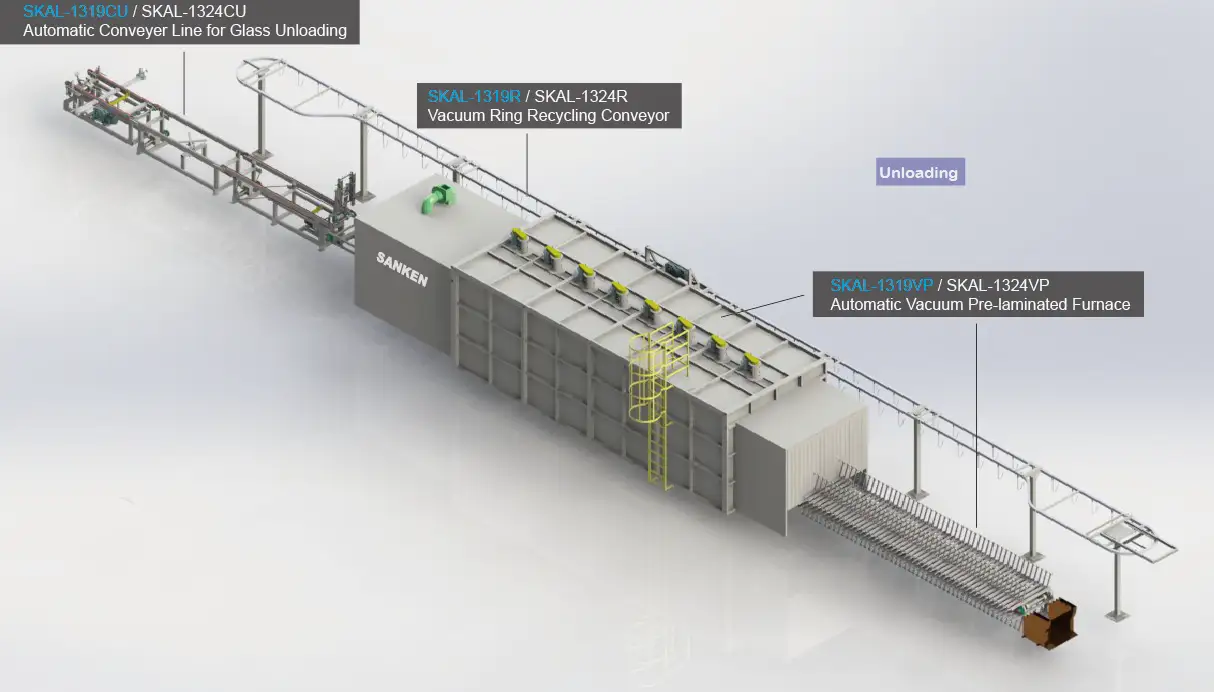
The SANKEN SKAL-VP series prepares assembled automotive glass for final autoclave bonding. The line combines conveying through the clean assembly area, a vacuum pre-lamination furnace, unloading conveying and a vacuum ring return system. Select the equipment combination around glass dimensions, curvature, interlayer structure and production requirements.
- Configuration groups: SKAL-1319 and SKAL-1324.
- CA section: Assembly conveying through the clean-room workstations.
- VP section: Vacuum pre-lamination before autoclave processing.
- CU section: Glass unloading and downstream conveying.
- R section: Vacuum ring return for reuse.
- Control system: PLC and touch screen.
- SKAL-1319 glass range: 900 × 600 mm to 1900 × 1300 mm.
- SKAL-1319 paired thickness: 2+2 mm to 4+4 mm.
- SKAL-1319VP output: 60–90 pieces/hour.
- SKAL-1319CA/CU conveying speed: 1–10 m/min.
Automotive Glass Vacuum Pre-Lamination Line
SANKEN SKAL-VP series connects clean-room assembly conveying, vacuum pre-lamination, glass unloading and vacuum ring return for automotive laminated glass production. PLC and touch-screen control coordinate the line before the assembled glass proceeds to final autoclave processing.
The production arrangement uses four equipment groups: CA assembly conveyor, VP vacuum pre-lamination furnace, CU unloading conveyor and R vacuum ring return conveyor. SKAL-1319 and SKAL-1324 configurations are available for project selection.
Main Line Components
Clean-Room Assembly Conveyor: CA
SKAL-1319CA and SKAL-1324CA provide the conveying arrangement for the clean assembly area. The workstation sequence supports glass loading, checking, interlayer assembly and vacuum ring fitting before pre-lamination.
Vacuum Pre-Lamination Furnace: VP
SKAL-1319VP and SKAL-1324VP perform the vacuum pre-lamination stage on the assembled glass. The furnace is coordinated with the assembly and unloading conveyors for transfer through the process.
Glass Unloading Conveyor: CU
SKAL-1319CU and SKAL-1324CU convey glass out of the pre-lamination section and support the downstream handling arrangement.
Vacuum Ring Return Conveyor: R
SKAL-1319R and SKAL-1324R return the vacuum rings within the production area for reuse. Plan the return route around the assembly station and glass unloading arrangement.
Control and Process Integration
PLC and Touch-Screen Control
Centralized PLC and touch-screen control provide access to line operation and process settings. Coordinate the assembly conveying, furnace, unloading and ring return sections for the selected production arrangement.
Assembly Room Connection
The conveying system connects the clean assembly area with the vacuum pre-lamination furnace. Arrange glass checking, interlayer preparation and ring fitting around the required laminate structure.
Separate Conveying and Processing Specifications
Assembly and unloading conveyors have transport speeds expressed in m/min. Furnace output is expressed in pieces/hour. Match these specifications through the complete workstation and processing sequence.
Autoclave Preparation
Vacuum pre-lamination prepares the assembled glass for the subsequent autoclave stage. Coordinate the downstream transfer, batch loading and autoclave capacity with the required line output.
SKAL-1319 Configuration Specifications
| Parameter | SKAL-1319CA | SKAL-1319VP |
|---|---|---|
| Equipment Function | Assembly conveyor | Vacuum pre-lamination furnace |
| Max. Glass Size | 1900 × 1300 mm | 1900 × 1300 mm |
| Min. Glass Size | 900 × 600 mm | 900 × 600 mm |
| Paired Glass Thickness | 2+2 to 4+4 mm | 2+2 to 4+4 mm |
| Conveying Speed | 1–10 m/min | — |
| Pre-Lamination Output | — | 60–90 pieces/hour |
| Component Power | 2.6 kW | 235 kW |
| Occupied Space (L × W × H) | 9500 × 800 × 900 mm | 16000 × 3900 × 2950 mm |
| Ring Conveyor Route Length | — | — |
| Equipment Weight | 2000 kg | Confirm configuration |
| Parameter | SKAL-1319CU | SKAL-1319R |
|---|---|---|
| Equipment Function | Unloading conveyor | Vacuum ring return conveyor |
| Max. Glass Size | 1900 × 1300 mm | — |
| Min. Glass Size | 900 × 600 mm | — |
| Paired Glass Thickness | 2+2 to 4+4 mm | — |
| Conveying Speed | 1–10 m/min | — |
| Pre-Lamination Output | — | — |
| Component Power | 6.5 kW | 2.2 kW |
| Occupied Space (L × W × H) | 8150 × 800 × 900 mm | — |
| Ring Conveyor Route Length | — | 22 m |
| Equipment Weight | 2200 kg | 4000 kg |
Paired glass thickness describes the two glass sheets, from 2+2 mm to 4+4 mm. Furnace output is expressed as pre-laminated pieces per hour; conveyor speed is expressed as transport movement in m/min.
The 235 kW figure applies to SKAL-1319VP. Assembly conveying, unloading and ring return have separate component power ratings. Confirm the complete equipment scope and electrical demand for the production arrangement.
The 22 m dimension is the ring conveyor route length. It is separate from the occupied-space dimensions of the glass conveying and furnace sections. Furnace weight is confirmed for the selected configuration.
SKAL-1324 Configuration
The corresponding equipment groups are SKAL-1324CA assembly conveying, SKAL-1324VP vacuum pre-lamination, SKAL-1324CU unloading conveying and SKAL-1324R vacuum ring return.
Send the required glass dimensions, paired-sheet thicknesses, windshield geometry, production target and workshop drawing so we can confirm the operating range, equipment dimensions and utility requirements of the selected SKAL-1324 arrangement.
Automotive Glass Pre-Lamination Workflow
Clean-Room Glass Checking & Assembly → Vacuum Ring Fitting → Vacuum Pre-Lamination → Glass Unloading → Transfer for Autoclave Processing
Prepare and Assemble the Glass
Prepare the glass pair and interlayer according to the intended windshield build-up. Check and assemble the glass in the clean-room workstation arrangement.
Fit the Vacuum Ring
Fit the appropriate vacuum ring for the glass design and move the assembly toward the furnace through the conveying section.
Perform Vacuum Pre-Lamination
The assembled glass passes through the vacuum pre-lamination furnace under the selected processing conditions.
Transfer Glass and Return Rings
Coordinate unloading and vacuum ring handling with the downstream transfer route. The ring conveyor returns rings to the designated preparation area for reuse.
Continue Autoclave Processing
Transfer the prepared laminate to a separate autoclave for final bonding according to the selected glass-and-interlayer process.
Factory Layout and Equipment Selection
Plan the clean assembly room, furnace, unloading conveyor and ring return route together. Keep the glass flow connected while allowing access for checking, assembly, ring fitting and maintenance.
For the SKAL-1319 arrangement, assembly conveying occupies 9500 × 800 × 900 mm, the VP furnace occupies 16000 × 3900 × 2950 mm, and unloading conveying occupies 8150 × 800 × 900 mm. The ring conveyor route length is 22 m.
These figures describe separate components and do not define the overall factory footprint. Arrange their positions, assembly room boundaries, operator work areas and autoclave transfer route for the actual workshop.
Select the line around glass size, curvature, paired thickness, interlayer requirements, ring design and target output. Confirm the connections and utility requirements of the final equipment combination.
Frequently Asked Questions
What does the complete line include?
The arrangement combines assembly conveying in the clean room, a vacuum pre-lamination furnace, an unloading conveyor and a vacuum ring return conveyor.
Which configuration groups are available?
The SKAL-1319 and SKAL-1324 groups each include CA assembly conveying, VP vacuum pre-lamination, CU unloading and R vacuum ring return equipment.
What is the SKAL-1319 glass size range?
The assembly conveyor, VP furnace and unloading conveyor cover glass from 900 × 600 mm to 1900 × 1300 mm, with paired glass thicknesses of 2+2 mm to 4+4 mm.
What is the SKAL-1319VP output?
Furnace output is 60–90 pieces/hour. Actual production depends on the glass structure, processing settings and the flow through assembly and handling stations.
Is 235 kW the power of the entire line?
It is the SKAL-1319VP furnace power. Assembly conveying is 2.6 kW, unloading conveying is 6.5 kW and the ring return conveyor is 2.2 kW.
Does vacuum pre-lamination complete the whole lamination process?
For the process described here, vacuum pre-lamination is followed by final autoclave bonding. Plan the autoclave and transfer system alongside the line.
What is the ring conveyor used for?
It returns vacuum rings through the production area for reuse at the preparation and assembly stations.
What should I send for a quotation?
Send glass dimensions and curvature drawings, paired thicknesses, interlayer details, ring requirements, target output, clean-room layout, factory dimensions and autoclave details.
Plan Your Automotive Vacuum Pre-Lamination Line
SANKEN has been exporting glass-processing machinery since 2002. Send us your automotive glass specifications to discuss the assembly conveying, vacuum pre-lamination, unloading and ring return configuration.
Contact SANKEN for configuration selection and a line quotation.
SANKEN Glass Machinery is a Guangzhou-based manufacturer and international supplier of glass-processing machinery and complete production-line solutions.
Contact Us
Contact: Dalia Qiu
Tel: +86 15994813914
Landline: +86-20-82347228
Email: sales@sankenglass.com
WhatsApp: +86 15994813914
ADD: No.2, Xinghai Road, Lanhe, Nansha District, Guangzhou City, China. P.C 511480