Exporting glass-processing machinery since 2002, with international project support from planning to installation and training.



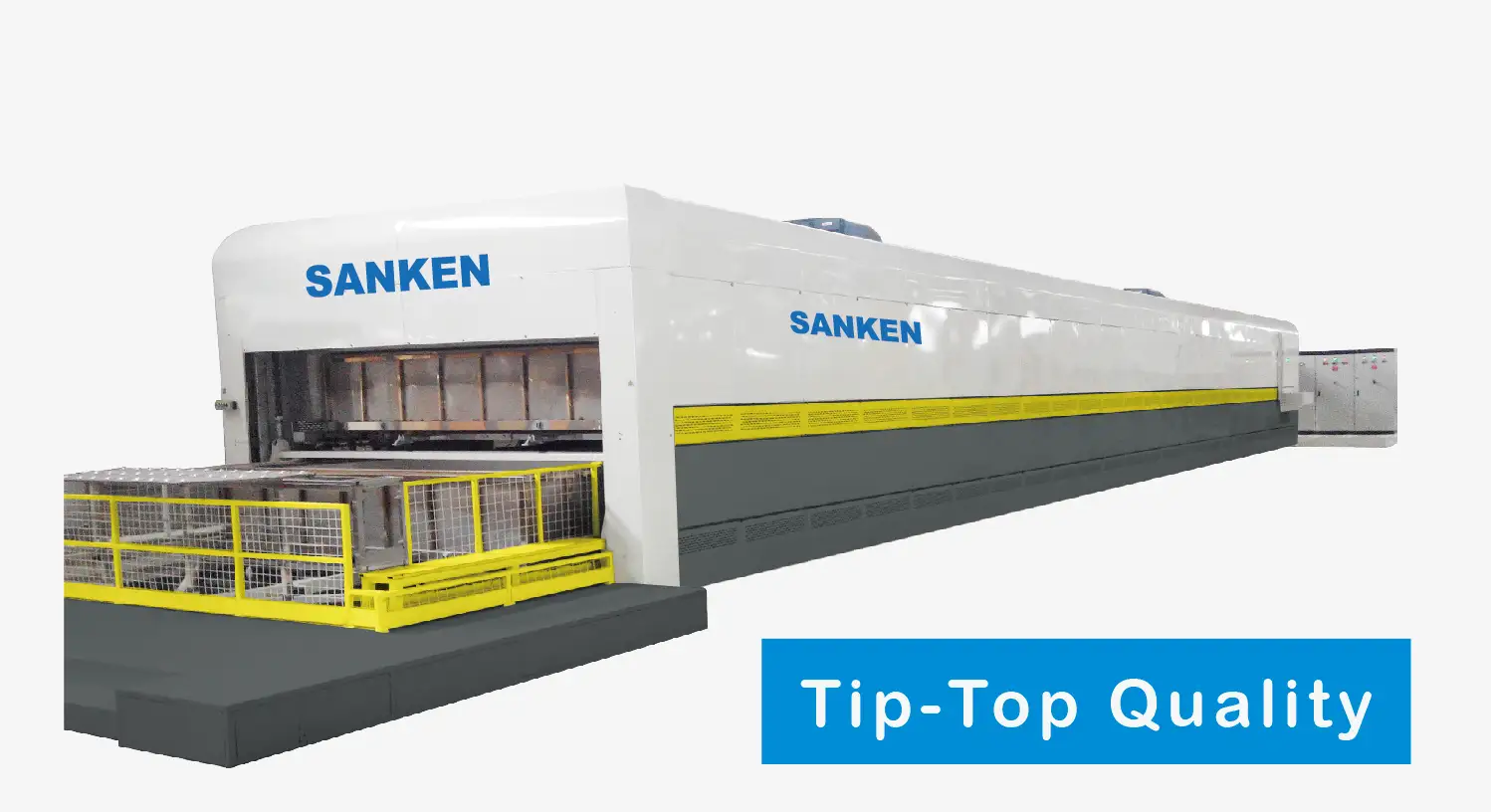
Automotive Windshield Glass Bending Furnace – SKAL-FB Series
The SANKEN SKAL-FB series forms curved glass pairs for subsequent windshield assembly and lamination. PLC and computer control coordinate heating, trolley movement and cooling. Mould-positioning mechanisms limit mould displacement during conveying, while variable-frequency blowers regulate airflow through the cooling-and-annealing section.
- Models: SKAL-1319FB and SKAL-1828FB.
- Maximum glass sizes: 1300 × 1900 mm and 1800 × 2800 mm, respectively.
- Paired glass thickness: 2+2 mm to 4+4 mm.
- Maximum bending depth: 300 mm or 400 mm, depending on the model.
- Trolley quantity: 24 for SKAL-1319FB; nine for SKAL-1828FB.
- Control system: PLC and computer with dynamic graphical display.
- Fault handling: Automatic warnings and fault records.
- Cooling: Controlled cooling and annealing with variable-frequency blowers.
- Mould handling: Positioning mechanisms on each trolley.
Automotive Front Windshield Glass Bending Furnace
SANKEN SKAL-FB series heats and bends paired glass sheets for automotive front windshield production. PLC and computer control coordinate furnace operation, with temperature control, mould-positioning trolleys and a cooling-and-annealing section for the forming process.
The series includes SKAL-1319FB and SKAL-1828FB. Maximum glass sizes are 1300 × 1900 mm and 1800 × 2800 mm respectively, with paired glass thicknesses from 2+2 mm to 4+4 mm. Select the furnace around the windshield size, bending geometry and required production arrangement.
Main Features
PLC and Computer Control
The furnace uses PLC and computer control with a dynamic graphical display. Operators can view the equipment status and access the controls for the selected forming process.
Fault Warnings and Records
When a fault occurs, the control system provides a warning and records the fault information. Operators can review the information on the computer to support troubleshooting.
Temperature and Heater Output Control
Temperature control regulates heater output during the glass forming process. Configure the thermal conditions for the selected glass pair, mould and windshield geometry.
Trolley Mould Positioning
Each trolley has a mould-positioning mechanism to limit mould displacement during conveying. The positioning arrangement supports consistent placement of the glass pair through the bending process.
Cooling and Annealing
The furnace incorporates a continuous cooling-and-annealing structure. Variable-frequency blowers adjust airflow to suit the cooling conditions of the selected process.
Limit Protection
Multiple limit-protection functions monitor equipment movement as part of the furnace control arrangement.
Technical Specifications
| Parameter | SKAL-1319FB | SKAL-1828FB |
|---|---|---|
| Max. Glass Size | 1300 × 1900 mm | 1800 × 2800 mm |
| Paired Glass Thickness | 2+2 to 4+4 mm | 2+2 to 4+4 mm |
| Max. Bending Depth | 300 mm | 400 mm |
| Trolley Quantity | 24 | 9 |
| Productivity per 8 Hours | 250–300 pairs | 16–20 pairs |
| Compressed-Air Pressure | 6–8 bar | 6–8 bar |
| Total Power | 2230 kW | 750 kW |
| Occupied Space (L × W × H) | 23500 × 5100 × 2850 mm | 22900 × 7200 × 3450 mm |
| Machine Weight | 55 tonnes | 35 tonnes |
Paired glass thickness describes the two sheets processed together: 2+2 mm through 4+4 mm. Productivity is expressed as glass pairs per 8 hours.
Bending depth and glass size are separate selection limits. Confirm the complete windshield geometry, mould arrangement and production target when specifying the furnace.
Total power is the equipment power rating in kW. Actual energy consumption depends on the process, loading and operating schedule.
Furnace Configuration and Model Selection
Glass Size and Bending Geometry
SKAL-1319FB handles glass up to 1300 × 1900 mm with a maximum bending depth of 300 mm. SKAL-1828FB handles glass up to 1800 × 2800 mm with a maximum bending depth of 400 mm.
Trolleys and Production Arrangement
SKAL-1319FB has 24 trolleys and a circulating conveying arrangement with upper-level entry and lower-level discharge. SKAL-1828FB has nine trolleys. Match the trolley arrangement and loading plan to the selected model.
Model-Specific Output
SKAL-1319FB has a productivity range of 250–300 pairs per 8 hours; SKAL-1828FB has a range of 16–20 pairs per 8 hours. Review panel size, shape, mould requirements and the complete process when selecting the production configuration.
Position in Windshield Manufacturing
Prepared Glass Pairs → Mould and Trolley Loading → Heating and Bending → Controlled Cooling and Annealing → Downstream Windshield Assembly and Lamination
Prepare the Glass Pair
Complete the required cutting, edging and other upstream preparation according to the windshield design. Match the paired sheets and mould arrangement to the intended curved-glass structure.
Form the Required Curvature
The furnace heats the glass pair on the mould through the selected forming process. Temperature control and trolley mould positioning support the required bending arrangement.
Cool and Anneal
The formed glass passes through controlled cooling and annealing, with adjustable blower airflow for the process conditions.
Continue Downstream Processing
The curved glass pair proceeds to the subsequent windshield assembly, interlayer and lamination stages specified for the product. Coordinate transfer and handling with the rest of the production line.
Factory Layout and Utilities
Plan the furnace together with the glass-pair preparation area, mould handling, trolley circulation and downstream transfer route. Leave access for mould changes, equipment servicing and glass movement.
SKAL-1319FB occupies 23500 × 5100 × 2850 mm, and SKAL-1828FB occupies 22900 × 7200 × 3450 mm. Coordinate these equipment arrangements with factory access, surrounding work areas and installation requirements.
Compressed-air pressure is 6–8 bar. Rated total power is 2230 kW for SKAL-1319FB and 750 kW for SKAL-1828FB. Confirm the electrical installation and utility connections for the selected furnace configuration.
Frequently Asked Questions
Which models are included?
The series includes SKAL-1319FB and SKAL-1828FB.
What glass sizes and bending depths can the furnaces handle?
SKAL-1319FB handles up to 1300 × 1900 mm with a maximum bending depth of 300 mm. SKAL-1828FB handles up to 1800 × 2800 mm with a maximum bending depth of 400 mm.
What does 2+2 to 4+4 mm mean?
It describes paired sheets, from two 2 mm sheets to two 4 mm sheets. Send the required glass build-up for process and configuration review.
Do both models have 24 trolleys?
SKAL-1319FB has 24 trolleys, while SKAL-1828FB has nine. Select the trolley and handling arrangement for the chosen furnace.
How is productivity expressed?
Productivity is measured in glass pairs per 8 hours: 250–300 pairs for SKAL-1319FB and 16–20 pairs for SKAL-1828FB.
How are faults displayed?
The PLC and computer system provides fault warnings and records, allowing operators to review fault information on the computer.
How is cooling controlled?
The cooling-and-annealing section uses variable-frequency blowers to adjust airflow for the selected process.
What information is required for a quotation?
Send the maximum windshield dimensions, glass-pair thicknesses, curvature drawings, bending depth, mould requirements, target output, factory layout and available utilities.
Plan Your Windshield Glass Bending Equipment
SANKEN has been exporting glass-processing machinery since 2002. Send us your windshield drawings and production requirements to discuss the furnace model, mould arrangement and factory integration.
SANKEN Glass Machinery is a Guangzhou-based manufacturer and international supplier of glass-processing machinery and complete production-line solutions.
Contact Us
Contact: Dalia Qiu
Tel: +86 15994813914
Landline: +86-20-82347228
Email: sales@sankenglass.com
WhatsApp: +86 15994813914
ADD: No.2, Xinghai Road, Lanhe, Nansha District, Guangzhou City, China. P.C 511480