Exporting glass-processing machinery since 2002, with international project support from planning to installation and training.



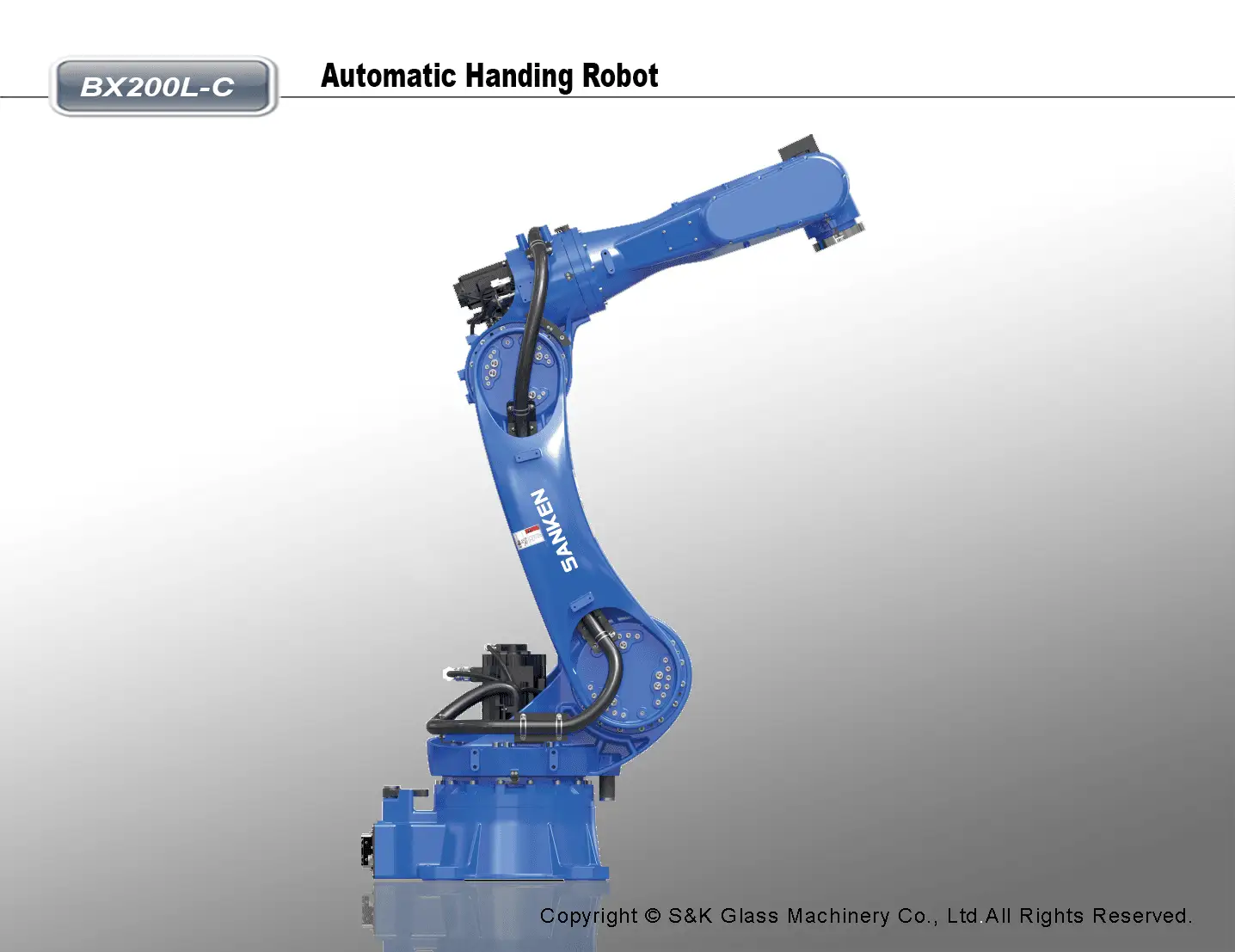
Automatic 6-Axis Glass Loading & Unloading Robot (BX200L-C)
Six-Axis Articulated Robots are used for automated glass handling, loading, unloading and transfer between production stations.
Three robot models are available: RS050N-B, RS080N-B and BX200L-C. They offer load capacities from 50 to 200 kg, with a repeating positioning accuracy of ±0.06 mm.
The BX200L-C configuration supports glass dimensions up to 2500 × 1500 mm and thicknesses of 3–12 mm.
Robot selection and integration depend on glass size, load weight, gripper design, handling direction and the production-line layout.
Six-Axis Articulated Robot for Glass Handling
Six-axis articulated robots are used to automate glass loading, unloading and transfer operations in glass-processing facilities. Their multi-joint construction allows glass sheets to be picked up, repositioned and transferred between production stations along programmed paths.
Three models are available: RS050N-B, RS080N-B and BX200L-C. Maximum robot load capacities range from 50 kg to 200 kg, with different glass size and thickness specifications for each model.
SANKEN can incorporate these robots into glass-handling systems with application-specific gripping equipment and production-line controls. The final arrangement is determined by the glass dimensions, handling load, required movement and factory layout.
BX200L-C Six-Axis Articulated Robot
Glass Handling Functions
Automatic Glass Loading
The robot can pick up glass sheets from a designated loading position and place them at the entrance of a processing station. Glass gripping and positioning equipment are configured for the required sheet size and handling direction.
Glass Unloading
After processing, the robot can transfer glass from the equipment discharge position to a receiving rack or another designated location within the handling system.
Transfer Between Production Stations
Programmed robot movements can be used for material transfer between connected equipment stations, reducing repeated manual lifting and repositioning of glass sheets.
Six-Axis Positioning
The articulated structure provides six axes of movement for positioning glass-handling tools. Robot motion and placement positions can be programmed to suit the designated production task.
Repeatable Handling Operations
All three robot models have a repeating positioning accuracy of ±0.06 mm. This specification relates to robot positioning repeatability; actual glass placement performance also depends on the end-of-arm tooling, mounting structure and system setup.
Glass Handling Sequence
The robot follows a programmed handling sequence. A suitable gripping system secures the glass before movement, and the robot transfers it to the designated position.
The movement path, gripping method and equipment signals are established during system integration.
Robot Structure and Details
Equipment views of the BX200L-C articulated robot used in glass-handling applications.
Robot Side View
Robot Structure
Robot Arm Details
Technical Specifications
Compare the three robot models by supported glass dimensions, thickness range, load capacity and equipment weight.
| Model | Max. Glass Size | Min. Glass Size | Glass Thickness | Handling Rate | Repeating Positioning Accuracy | Max. Load Capacity | Robot Weight |
|---|---|---|---|---|---|---|---|
| RS050N-B | 1300 × 1300 mm | 300 × 200 mm | 3–8 mm | 5–8 pcs/min | ±0.06 mm | 50 kg | 555 kg |
| RS080N-B | 2200 × 1000 mm | 400 × 200 mm | 3–12 mm | 5–8 pcs/min | ±0.06 mm | 80 kg | 555 kg |
| BX200L-C | 2500 × 1500 mm | 400 × 300 mm | 3–12 mm | 5–8 pcs/min | ±0.06 mm | 200 kg | 890 kg |
Handling speed is subject to the programmed movement, glass dimensions, gripping equipment and production-line arrangement. Final system performance should be confirmed during project planning.
Choosing the Right Robot Model
RS050N-B — 50 kg Load Capacity
The RS050N-B supports glass sizes up to 1300 × 1300 mm and thicknesses from 3 to 8 mm. Its maximum robot load capacity is 50 kg.
RS080N-B — 80 kg Load Capacity
The RS080N-B supports glass sizes up to 2200 × 1000 mm and thicknesses from 3 to 12 mm. It provides a maximum load capacity of 80 kg.
BX200L-C — 200 kg Load Capacity
The BX200L-C supports glass sizes up to 2500 × 1500 mm and thicknesses from 3 to 12 mm. Its maximum robot load capacity is 200 kg, making it the highest-load configuration among the three listed models.
Robot load capacity must be assessed together with the weight of the glass-handling tool and the workpiece. The final selection also depends on the movement path, robot reach and installation layout.
Production Line Integration
Robot handling equipment can be incorporated into glass-processing operations for loading, unloading and transfer between stations. Each installation requires a suitable combination of robot hardware, end-of-arm tooling and machine interfaces.
Glass Gripping Equipment
The gripping arrangement is selected according to the dimensions, weight and surface characteristics of the glass. The gripper must be included when assessing the robot's total handling load.
Robot Reach and Installation
The robot position and working envelope should be reviewed against the pickup location, placement location, transfer path and available factory space.
Equipment Communication
Loading and unloading operations require coordination between the robot controller and the connected production equipment. The control interface and operating sequence are defined for each project.
Safety Planning
Robot guarding, emergency stops, access control and operating procedures should be considered during system design and installation.
Applications
Six-axis articulated robots can be used in glass-processing factories for repetitive material handling tasks, particularly where glass must be transferred between fixed pickup and placement locations.
Common applications include glass loading, unloading, station-to-station transfer and automated placement within production handling systems.
Frequently Asked Questions
Which six-axis robot models are available?
Three models are available: RS050N-B, RS080N-B and BX200L-C, with maximum load capacities of 50 kg, 80 kg and 200 kg respectively.
What is the maximum glass size for the BX200L-C?
The BX200L-C supports glass dimensions up to 2500 × 1500 mm and a thickness range of 3–12 mm within the specified handling configuration.
Does a 200 kg robot load capacity mean it can carry 200 kg of glass?
The maximum robot load capacity is 200 kg. The weight of the gripping equipment and glass must be considered together when checking the allowable handling load.
What is the repeating positioning accuracy?
All three models have a specified repeating positioning accuracy of ±0.06 mm. Actual glass placement performance also depends on the gripping system and the complete installation.
What is the handling speed?
The specified handling rate is 5–8 pieces per minute. Actual throughput depends on the travel distance, programmed movements, glass dimensions and connected equipment.
Can the robot be integrated with existing glass-processing equipment?
Integration can be reviewed based on the equipment interfaces, factory layout, handling requirements and available installation space.
How do I select a robot for glass handling?
The main selection factors are glass dimensions, thickness, weight, required handling direction, gripping method, robot reach and production cycle requirements.
Robot Selection and Integration Support
For a robot handling proposal, provide the glass dimensions, thickness, weight, pickup and placement positions, required cycle time and factory layout. These details can be used to review the robot model, gripping arrangement and integration requirements.
SANKEN Glass Machinery is a Guangzhou-based manufacturer and international supplier of glass-processing machinery and complete production-line solutions.
Contact Us
Contact: Dalia Qiu
Tel: +86 15994813914
Landline: +86-20-82347228
Email: sales@sankenglass.com
WhatsApp: +86 15994813914
ADD: No.2, Xinghai Road, Lanhe, Nansha District, Guangzhou City, China. P.C 511480