Exporting glass-processing machinery since 2002, with international project support from planning to installation and training.



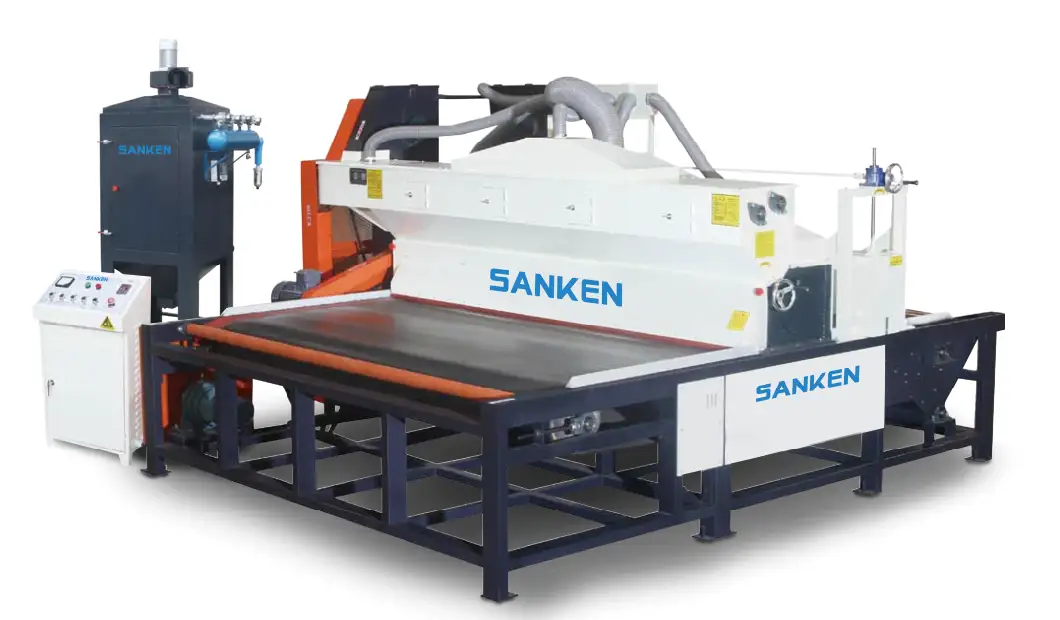
Horizontal Glass Sandblasting Machine – SKS-H Series
-
The SANKEN SKS-H series creates frosted glass surfaces using rotating blades to project abrasive mechanically. The blasting process requires no external air compressor, while horizontal conveying, abrasive screening and broken-glass separation support production.
- Four models: SKS-1600H, SKS-2000H, SKS-2500H and SKS-3100H.
- Maximum glass widths: 1500, 1900, 2500 and 3000 mm.
- Glass thickness range: 3–25 mm.
- Eight-blade centrifugal blasting assembly.
- Automatic abrasive recycling and broken-glass separation.
- Wet dust filtration and variable-frequency conveyor control.
Horizontal Glass Sandblasting Without an Air Compressor
The SANKEN SKS-H series uses motor-driven centrifugal blasting to create frosted surfaces on flat glass. Rotating blades project abrasive onto the glass, so the blasting process does not require an external air compressor.
Four models cover maximum glass widths from 1500 to 3000 mm and glass thicknesses of 3–25 mm. Horizontal conveying, abrasive recycling and broken-glass separation support production for different glass sizes.
Mechanical Blasting and Abrasive Handling
Motor-Driven Centrifugal Blasting
An eight-blade blasting assembly projects abrasive mechanically onto the glass surface. This removes the compressed-air requirement of the blasting process.
Broken-Glass Separation
The separation system removes broken glass from the abrasive stream and discharges the fragments outside the machine frame. Separated abrasive returns to the recycling system.
Abrasive Recycling and Screening
Abrasive circulates through three independent screening layers. The screening system separates glass particles and fine material from the reusable abrasive.
Wet Dust Filtration
A water-tank filtration system captures dust through contact between the extracted air and water. Tank cleaning and residue removal form part of routine maintenance.
40Cr Main Spindle
The main blasting shaft uses solid 40Cr steel with heat treatment and dynamic balancing. Spindle diameters range from 70 to 110 mm across the series.
Bearing Protection
Sand deflectors, dust covers and protective rubber pads provide three layers of protection around the spindle bearing seats.
Horizontal Conveyor
A continuous rubber conveyor belt transports glass through the blasting section. Variable-frequency speed control allows the conveyor setting to be adjusted for the required finish.
Working Sequence
During processing, the abrasive handling system collects, screens and returns reusable media to the blasting assembly. Select the abrasive and conveyor settings around the required surface finish.
Technical Specifications
| Parameter | SKS-1600H | SKS-2000H | SKS-2500H | SKS-3100H |
|---|---|---|---|---|
| Max. Glass Width | 1500 mm | 1900 mm | 2500 mm | 3000 mm |
| Min. Glass Size | 200 × 200 mm | 200 × 200 mm | 200 × 200 mm | 300 × 300 mm |
| Glass Thickness | 3–25 mm | 3–25 mm | 3–25 mm | 3–25 mm |
| Main Spindle Diameter | 70 mm | 80 mm | 80 mm | 110 mm |
| Blasting Tool Blades | 8 pcs | 8 pcs | 8 pcs | 8 pcs |
| Max. Processing Output | 63 m²/h | 79.8 m²/h | 105 m²/h | 126 m²/h |
| Total Machine Power | 4.8 kW | 7.1 kW | 9.9 kW | 10.25 kW |
| Air Compressor Required | No | No | No | No |
| Machine Dimensions | 3000 × 2500 × 2000 mm | 3500 × 2900 × 2000 mm | 3500 × 3500 × 2000 mm | 4200 × 4300 × 2000 mm |
| Machine Weight | 2.0 t | 2.4 t | 2.8 t | 3.2 t |
Frosted Glass Applications
Use the SKS-H series for flat glass frosting in architectural and decorative applications, including privacy panels, partitions, doors and furniture glass.
Select the model by actual glass width rather than the model number alone. The maximum glass widths are 1500 mm for SKS-1600H, 1900 mm for SKS-2000H, 2500 mm for SKS-2500H and 3000 mm for SKS-3100H.
Equipment Views
Installation and Production Planning
Plan space for the machine, glass loading and unloading, abrasive handling, water-tank access and maintenance. Check the selected model dimensions against the workshop entrance and available floor area.
The blasting process does not need an air compressor. Electrical power, water-tank arrangements and cleaning access remain part of installation planning. Send us your glass dimensions, thickness range, finish requirements and factory plan so we can review the equipment configuration.
Contact SANKEN for model selection and factory layout planning.
Frequently Asked Questions
Why is an air compressor unnecessary?
The machine uses rotating motor-driven blades to project abrasive onto the glass instead of compressed-air blasting nozzles.
Which glass thicknesses can the series process?
All four models process glass thicknesses of 3–25 mm. Select the model by glass width, minimum glass size and production requirements.
How is broken glass handled?
The separation system removes fragments from the abrasive stream and discharges them outside the frame. Reusable abrasive returns to circulation.
How is the abrasive recycled?
The abrasive passes through a circulation and screening system with three independent filtration screens before returning to the blasting assembly.
What maintenance does the machine need?
Inspect the blasting blades, conveyor, spindle bearing protection and screening components. Clean the dust filtration tank and remove collected residues as part of routine maintenance.
What information is needed for a quotation?
Send your largest and smallest glass sizes, glass thickness range, required finish, target output, power supply and available factory space.
SANKEN Glass Machinery is a Guangzhou-based manufacturer and international supplier of glass-processing machinery and complete production-line solutions.
Contact Us
Contact: Dalia Qiu
Tel: +86 15994813914
Landline: +86-20-82347228
Email: sales@sankenglass.com
WhatsApp: +86 15994813914
ADD: No.2, Xinghai Road, Lanhe, Nansha District, Guangzhou City, China. P.C 511480