Exporting glass-processing machinery since 2002, with international project support from planning to installation and training.



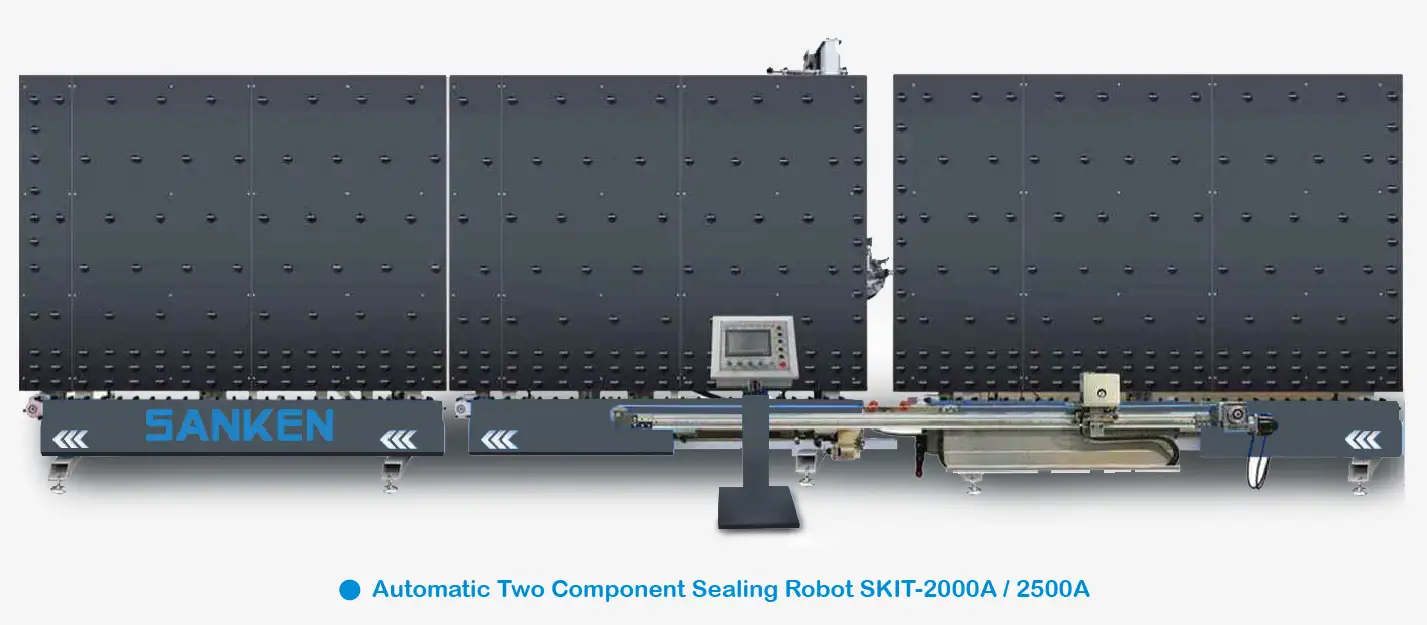
Insulating Glass Sealing Robot & Two-Component Extruder – SKIT Series
The SANKEN SKIT series applies secondary sealant to assembled insulating glass units. SKIT-2000A and SKIT-2500A combine CNC and servo control with automatic size detection, nozzle centering, sealing-depth detection and corner finishing. SKIT-02 provides a separate two-component sealant extrusion system.
- Models: SKIT-2000A, SKIT-2500A and SKIT-02.
- Maximum processing size: 2000 × 3000 mm or 2500 × 3500 mm, depending on the model.
- Individual glass thickness: 3–12 mm.
- Total IGU thickness: 12–56 mm.
- Spacer thickness: 6–27 mm.
- Sealing depth: 3–15 mm.
- Automatic robots: Detect unit dimensions and sealing depth, with automatic nozzle centering and sealant delivery adjustment.
- SKIT-02 extruder: Adjustable component proportioning, mixing and sealant-gun application.
Insulating Glass Secondary Sealing Equipment
SANKEN SKIT series provides automatic sealing robots and a two-component sealant extruder for the secondary edge sealing of insulating glass units. Choose SKIT-2000A or SKIT-2500A for automatic sealing connected to an IG production line, or SKIT-02 for sealant proportioning, mixing and gun application at a separate sealing station.
The automatic robots combine CNC and servo control with IGU size detection, nozzle centering and sealing-depth detection. SKIT-02 uses a high-pressure plunger pump and an adjustable proportioning system to feed and mix the two sealant components.
Automatic Sealing Robots: SKIT-2000A and SKIT-2500A
CNC and Servo Control
CNC control, servo motors and drives coordinate sealant application around the IGU perimeter. The robots can connect downstream of the main insulating glass line to automate secondary sealing.
Automatic Size and Thickness Detection
The system detects the dimensions and thickness of incoming insulating glass units to support sealing adjustment for different unit sizes.
Automatic Nozzle Centering
The centering system positions the sealing nozzle relative to the aluminium spacer frame, helping align the nozzle with the edge cavity during application.
Sealing-Depth Detection and Speed Adjustment
The robot detects sealing depth and adjusts application speed and sealant delivery to suit the edge cavity. Set the process for the selected spacer, unit structure and sealant.
Corner Finishing
Automatic corner finishing controls nozzle movement and sealant application at the corners of the unit, supporting a continuous perimeter seal.
Electrical Components
The automatic sealing robots use Schneider low-voltage electrical components. The operator interface provides access to operating settings and sealing controls.
Two-Component Sealant Extruder: SKIT-02
SKIT-02 supplies mixed two-component sealant through an application gun for insulating glass secondary sealing. It provides a separate sealing arrangement for factories using a sealing table or a dedicated application station.
High-Pressure Material Delivery
A high-pressure plunger pump and dual-component material feed deliver the sealant components to the mixing system. The feed arrangement supports the handling of high-viscosity sealants.
Adjustable Proportioning
The proportioning system allows the component ratio to be adjusted for the selected sealant. Match the settings to the sealant supplier’s mixing instructions.
Mixing and Gun Application
The mixing system combines the components before delivery through the sealant gun. Adjust air pressure and application settings for the required sealing operation, and follow the cleaning procedure to manage mixed material in the flow path.
Sealant Selection
SKIT-02 can be configured for silicone, polysulfide and other suitable two-component sealants. Confirm compatibility, component ratio and material handling requirements before selecting the configuration.
Technical Specifications
| Parameter | SKIT-2000A | SKIT-2500A | SKIT-02 |
|---|---|---|---|
| Equipment Type | Automatic sealing robot | Automatic sealing robot | Two-component sealant extruder |
| Max. Processing Size | 2000 × 3000 mm | 2500 × 3500 mm | 2500 × 3500 mm |
| Min. Processing Size | 300 × 400 mm | 300 × 400 mm | 300 × 400 mm |
| Individual Glass Thickness | 3–12 mm | 3–12 mm | 3–12 mm |
| Total IGU Thickness | 12–56 mm | 12–56 mm | 12–56 mm |
| Sealant Application Speed | 10–25 m/min | 10–25 m/min | 3–10 m/min |
| Spacer Thickness | 6–27 mm | 6–27 mm | 6–27 mm |
| Sealing Depth | 3–15 mm | 3–15 mm | 3–15 mm |
| Air Pressure | 0.5–0.8 MPa | 0.5–0.8 MPa | 0.5–0.8 MPa |
| Total Power | 13 kW | 13 kW | 1.2 kW |
| Machine Dimensions (L × W × H) | 7950 × 3000 × 2800 mm | 8950 × 3000 × 3300 mm | 1500 × 950 × 2260 mm |
| Machine Weight | 2500 kg | 3500 kg | 600 kg |
The application speeds describe sealant application movement, rather than finished units per hour. Actual output depends on unit size, edge-cavity dimensions, sealant properties and handling time.
SKIT-2000A and SKIT-2500A are automatic sealing robots. SKIT-02 is a separate sealant extrusion system; its material-feeding and mixing functions do not provide the robot’s automatic glass handling or perimeter-tracking functions.
Secondary Sealing Process
1. Receive the Assembled IGU
The insulating glass unit reaches the sealing stage after spacer assembly and pressing. Where inert-gas filling is required, complete that stage on the main IG line before secondary sealing.
2. Set the Sealing Conditions
Select the sealant and operating settings for the spacer system, edge-cavity depth and finished unit structure. Check the component ratio and material supply before production.
3. Apply the Secondary Seal
The automatic robot detects the unit and controls nozzle positioning, sealing movement and corner finishing. With SKIT-02, the operator applies the mixed sealant through the gun using the selected handling arrangement.
4. Inspect and Transfer
Inspect the perimeter seal and corners, then transfer the unit for curing and subsequent handling according to the sealant supplier’s requirements.
Model Selection
SKIT-2000A
For automatic secondary sealing of IGUs up to 2000 × 3000 mm. The robot has a rated power of 13 kW and machine dimensions of 7950 × 3000 × 2800 mm.
SKIT-2500A
For automatic secondary sealing of IGUs up to 2500 × 3500 mm. The robot has a rated power of 13 kW and machine dimensions of 8950 × 3000 × 3300 mm.
SKIT-02
For a separate two-component sealant application station. The extruder has a rated power of 1.2 kW and machine dimensions of 1500 × 950 × 2260 mm. Provide the appropriate sealing table and glass handling arrangement for the units you produce.
Production-Line Layout
Place the automatic sealing robot after the main insulating glass assembly and pressing line. Coordinate conveying direction, working height, unit dimensions and downstream handling when planning the connection.
This arrangement combines SKIT sealing equipment with a SKIL insulating glass line and spacer preparation stations. We plan the equipment positions around your workshop dimensions, glass flow and required automation level.
Provide compressed air at 0.5–0.8 MPa and an electrical supply suitable for the selected model. Allow access for sealant containers, material changes, cleaning and maintenance, together with space for incoming units and finished-glass transfer.
Frequently Asked Questions
What is the difference between the three models?
SKIT-2000A and SKIT-2500A automatically apply secondary sealant around the IGU perimeter. SKIT-02 proportions, mixes and delivers two-component sealant through a gun at a separate application station.
Does the sealing robot wash or assemble the glass?
Glass washing, spacer positioning, assembly, gas filling and pressing take place on the upstream IG line. The SKIT robot performs secondary sealing after those operations.
What is the maximum IGU size?
SKIT-2000A handles up to 2000 × 3000 mm. SKIT-2500A handles up to 2500 × 3500 mm. The SKIT-02 application arrangement covers units up to 2500 × 3500 mm with suitable supporting handling equipment.
What unit thickness can the equipment process?
All three models cover total IGU thicknesses of 12–56 mm, individual glass thicknesses of 3–12 mm, spacer thicknesses of 6–27 mm and sealing depths of 3–15 mm. Check the complete build-up against all limits.
Does the robot adjust for different sealing depths?
Yes. The automatic robot detects sealing depth and adjusts application speed and sealant delivery for the edge cavity.
What details are needed for a quotation?
Send your maximum and minimum IGU dimensions, glass and spacer thicknesses, sealing depth, sealant type and component ratio, target output, existing line details and factory layout.
Discuss Your IGU Sealing Requirements
Send SANKEN your insulating glass specifications and required sealing arrangement. We can help select the robot or extruder and plan its connection with the rest of your production equipment.
SANKEN Glass Machinery is a Guangzhou-based manufacturer and international supplier of glass-processing machinery and complete production-line solutions.
Contact Us
Contact: Dalia Qiu
Tel: +86 15994813914
Landline: +86-20-82347228
Email: sales@sankenglass.com
WhatsApp: +86 15994813914
ADD: No.2, Xinghai Road, Lanhe, Nansha District, Guangzhou City, China. P.C 511480