Exporting glass-processing machinery since 2002, with international project support from planning to installation and training.

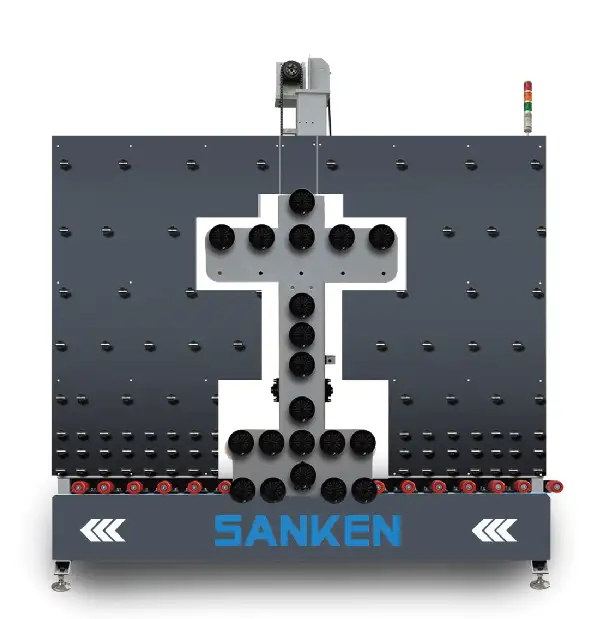
Automatic Glass Loading & Unloading Machine – SKIG Series
The SANKEN SKIG series transfers glass between racks and an insulating glass production line. PLC and touch-screen control coordinate servo-driven handling, reducing repeated manual glass transfer. Loading models stop automatically when the source rack is empty, while unloading models stop when the receiving rack is full, with a warning light prompting rack replacement.
- Loading models: SKIG-2000L and SKIG-2500L.
- Unloading models: SKIG-2000UL and SKIG-2500UL.
- Maximum glass size: 2000 × 3000 mm or 2500 × 3500 mm.
- Minimum glass size: 300 × 400 mm.
- Processing thickness: 4–12 mm.
- Processing speed: 0–12 m/min.
- Swing arm working angle: 84°–100°.
- Rated power: 10 kW for loading models; 12 kW for unloading models.
- Automatic functions: Servo-controlled handling, empty/full rack warning and automatic stop.
Automatic Glass Loading and Unloading
SANKEN SKIG series automates glass transfer between racks and an insulating glass production line. PLC and touch-screen control coordinate the handling process, while servo motors and drives control machine movement.
The series includes SKIG-2000L and SKIG-2500L loading machines, together with SKIG-2000UL and SKIG-2500UL unloading machines. Choose a 2000-size model for glass up to 2000 × 3000 mm or a 2500-size model for glass up to 2500 × 3500 mm.
Main Features
PLC and Touch-Screen Control
The PLC system and touch-screen interface provide centralized operation of the handling station. Operators use the interface to control the machine and set the handling process for the production arrangement.
Servo-Controlled Movement
Servo motors and drives control loading and unloading movements. The swing arm transfers glass between the rack position and the line, with a working angle of 84°–100°.
Rack-Status Warning and Automatic Stop
The loading machine provides a warning light and stops automatically when the source rack is empty. The unloading machine provides a warning light and stops automatically when the receiving rack is full, prompting the operator to change racks.
Connection with the Main IG Line
The machines can connect with the insulating glass main line to automate glass feeding and removal. This reduces repeated manual glass transfer at the line interface and helps coordinate handling with production.
Dedicated Loading and Unloading Models
L models perform glass loading, while UL models perform unloading. Select the required machines for each end of the line according to glass size, production flow and rack arrangement.
Loading and Unloading Process
Glass Loading: Rack to Production Line
Position the source rack at the loading station. The loading machine picks up and transfers glass to the line according to the handling sequence. When the rack is empty, the warning light and automatic stop prompt a rack change.
Glass Unloading: Production Line to Rack
Position the receiving rack at the unloading station. The unloading machine transfers glass from the line to the rack. When the rack is full, the warning light and automatic stop prompt a rack change.
Coordinate rack positions, conveying direction and the interface with the main line during production planning. Match the handling configuration to the actual glass dimensions, thickness, weight and surface condition.
Technical Specifications
Automatic Glass Loading Machines
SKIG-2000L and SKIG-2500L transfer glass from the rack to the production line.
| Parameter | SKIG-2000L | SKIG-2500L |
|---|---|---|
| Machine Type | Glass loader | Glass loader |
| Max. Processing Size | 2000 × 3000 mm | 2500 × 3500 mm |
| Min. Processing Size | 300 × 400 mm | 300 × 400 mm |
| Processing Thickness | 4–12 mm | 4–12 mm |
| Processing Speed | 0–12 m/min | 0–12 m/min |
| Swing Arm Working Angle | 84°–100° | 84°–100° |
| Air Supply Pressure | 0.6–0.8 MPa | 0.6–0.8 MPa |
| Total Power | 10 kW | 10 kW |
| Machine Dimensions (L × W × H) | 3150 × 2600 × 2900 mm | 3650 × 2600 × 3350 mm |
| Machine Weight | 1800 kg | 2000 kg |
Automatic Glass Unloading Machines
SKIG-2000UL and SKIG-2500UL transfer glass from the production line to the receiving rack.
| Parameter | SKIG-2000UL | SKIG-2500UL |
|---|---|---|
| Machine Type | Glass unloader | Glass unloader |
| Max. Processing Size | 2000 × 3000 mm | 2500 × 3500 mm |
| Min. Processing Size | 300 × 400 mm | 300 × 400 mm |
| Processing Thickness | 4–12 mm | 4–12 mm |
| Processing Speed | 0–12 m/min | 0–12 m/min |
| Swing Arm Working Angle | 84°–100° | 84°–100° |
| Air Supply Pressure | 0.6–0.8 MPa | 0.6–0.8 MPa |
| Total Power | 12 kW | 12 kW |
| Machine Dimensions (L × W × H) | 3150 × 2600 × 2900 mm | 3650 × 2600 × 3350 mm |
| Machine Weight | 1800 kg | 2000 kg |
Processing speed is expressed in m/min and does not represent loading or unloading cycles per minute. Actual handling output depends on glass dimensions, rack arrangement, transfer distance and coordination with the main line.
The processing thickness range is 4–12 mm. For handling assembled insulating glass units, confirm the complete unit thickness and weight with SANKEN before selecting the unloading configuration.
Choosing the Loading and Unloading Models
2000-Size Models
SKIG-2000L and SKIG-2000UL handle glass up to 2000 × 3000 mm. Each machine measures 3150 × 2600 × 2900 mm and weighs 1800 kg. Rated power is 10 kW for loading and 12 kW for unloading.
2500-Size Models
SKIG-2500L and SKIG-2500UL handle glass up to 2500 × 3500 mm. Each machine measures 3650 × 2600 × 3350 mm and weighs 2000 kg. Rated power is 10 kW for loading and 12 kW for unloading.
All four models share a minimum processing size of 300 × 400 mm, processing thickness of 4–12 mm, processing speed of 0–12 m/min and air supply pressure of 0.6–0.8 MPa.
Factory Layout and Line Integration
Plan loading and unloading positions together with the main insulating glass line. Leave space for source racks, receiving racks, rack replacement, the swing arm movement and maintenance access.
This insulating glass factory arrangement provides context for planning the main line and auxiliary stations. SKIG handling stations and rack positions are arranged separately according to the selected automation configuration and available workshop space.
Coordinate the station working height, conveying direction and controls with the connected equipment. Provide compressed air at 0.6–0.8 MPa and the electrical supply required by the selected loading or unloading model.
Frequently Asked Questions
Which models are available?
The series includes SKIG-2000L and SKIG-2500L loading machines, plus SKIG-2000UL and SKIG-2500UL unloading machines.
What is the difference between L and UL?
L models load glass from a rack onto the production line. UL models unload glass from the line onto a receiving rack.
What glass sizes can the machines handle?
The 2000-size models handle glass up to 2000 × 3000 mm, and the 2500-size models handle glass up to 2500 × 3500 mm. All four models have a minimum processing size of 300 × 400 mm.
What happens when a rack is empty or full?
The machine gives a warning light and stops automatically when the loading rack is empty or the unloading rack is full.
Can the machines connect to an insulating glass line?
Yes. The loading and unloading stations can connect with the main IG line. Confirm the working height, conveying direction, control interface and glass specifications when planning the connection.
Is 0–12 m/min the number of panels handled per minute?
No. It is a processing speed expressed in metres per minute. Panel handling output depends on the complete transfer cycle and production arrangement.
What information should I send for a quotation?
Send your required loading or unloading function, maximum and minimum glass dimensions, thickness, panel or unit weight, rack dimensions, existing line details and factory drawing.
Plan Your Glass Handling Stations
Send SANKEN your glass specifications, rack arrangement and main-line details. We can help select the loading and unloading models and plan their positions within your production flow.
SANKEN Glass Machinery is a Guangzhou-based manufacturer and international supplier of glass-processing machinery and complete production-line solutions.
Contact Us
Contact: Dalia Qiu
Tel: +86 15994813914
Landline: +86-20-82347228
Email: sales@sankenglass.com
WhatsApp: +86 15994813914
ADD: No.2, Xinghai Road, Lanhe, Nansha District, Guangzhou City, China. P.C 511480