Exporting glass-processing machinery since 2002, with international project support from planning to installation and training.



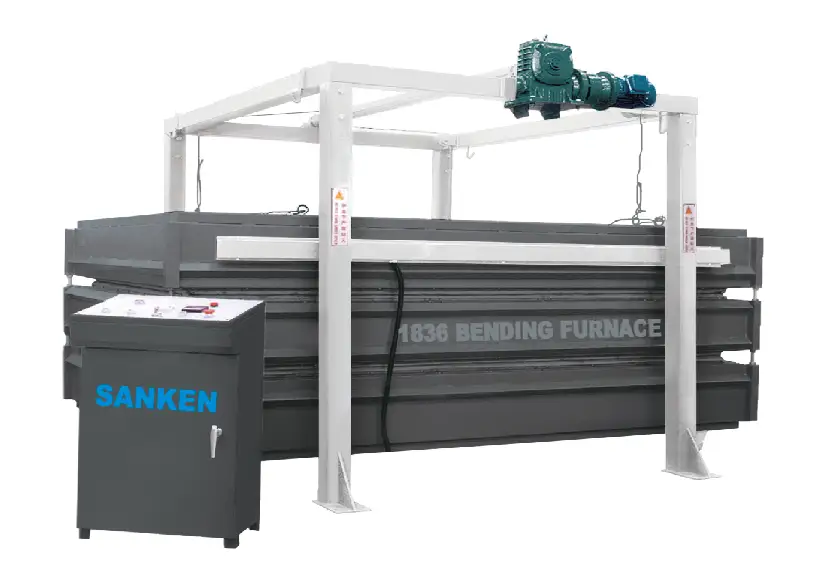
Glass Bending & Fusing Furnace – SKF Series
The SANKEN SKF series provides batch heating for glass bending and fusing. Automatic temperature control regulates heating, while individual heater groups allow adjustment for different products and tooling arrangements. An opening furnace cover provides access for loading glass and moulds.
- Models: SKF-1525, SKF-1830 and SKF-1836.
- Inner chamber sizes: 1500 × 2500 mm, 1800 × 3000 mm and 1800 × 3600 mm.
- Processing thickness: 3–25 mm.
- Bending depth: 700 mm.
- Maximum temperature: 900°C.
- Heating control: Automatic thermostat with individually controlled heater groups.
- Reference cycle: Approximately five hours, depending on the product and process.
- Total power: 112 kW, 160 kW or 195 kW, depending on the model.
- Applications: Glass wash basins, curved furniture glass, decorative fused glass and partition panels.
Glass Bending and Fusing Furnace
SANKEN SKF series provides batch heating for glass bending and fusing. Automatic temperature control and individually controlled heater groups support different hot-processing requirements for curved glass and decorative fused-glass products.
The range includes SKF-1525, SKF-1830 and SKF-1836, with inner chamber sizes from 1500 × 2500 mm to 1800 × 3600 mm. All three models have a maximum temperature of 900 °C, a processing thickness range of 3–25 mm and a bending depth of 700 mm.
Main Features
Glass Bending and Fusing
The furnace supports hot-processing work for curved glass and decorative fused-glass designs. Select the glass, mould and heating process according to the intended product.
Automatic Temperature Control
An automatic thermostat controls the heating temperature during bending and fusing. Establish the process conditions for the selected glass material, thickness and design.
Individually Controlled Heater Groups
Each heater group can be controlled individually, allowing heating to be adjusted for the workpiece and process arrangement.
Opening Furnace Cover
The opening cover provides access to the furnace chamber for placing and removing the glass and tooling. Plan the loading arrangement around the selected model and product dimensions.
Three Chamber Sizes
Choose 1500 × 2500 mm, 1800 × 3000 mm or 1800 × 3600 mm inner chamber dimensions. Check the glass and mould arrangement against the available chamber space.
Batch Production Cycle
A cycle takes approximately five hours as a reference. Actual cycle requirements depend on the glass material, thickness, shape, tooling and selected heating and cooling process.
Technical Specifications
| Parameter | SKF-1525 | SKF-1830 | SKF-1836 |
|---|---|---|---|
| Inner Chamber Size | 1500 × 2500 mm | 1800 × 3000 mm | 1800 × 3600 mm |
| Maximum Temperature | 900 °C | 900 °C | 900 °C |
| Processing Thickness | 3–25 mm | 3–25 mm | 3–25 mm |
| Bending Depth | 700 mm | 700 mm | 700 mm |
| Total Power | 112 kW | 160 kW | 195 kW |
| Machine Dimensions (L × W × H) | 2000 × 3000 × 2200 mm | 2300 × 3500 × 2200 mm | 2300 × 4100 × 2200 mm |
| Machine Weight | 2200 kg | 2800 kg | 3000 kg |
Inner chamber size describes the furnace interior. Confirm the usable product size with the mould dimensions, loading arrangement and clearance requirements.
The 900 °C value is the furnace maximum temperature. The operating temperature and cycle are selected for the specific bending or fusing process.
Total power is rated equipment power in kW. Actual energy consumption depends on the heating conditions, load and operating cycle.
Bending and Fusing Applications
Glass Wash Basins
The furnace can be used to form glass wash basins with suitable tooling and a process selected for the glass design.
Glass Tables and Furniture Components
Hot bending can produce curved glass for tea tables, coffee tables and other furniture components, according to the required shape and dimensions.
Curved Glass Panels
The equipment supports glass bending work for curved panels and decorative forms. Confirm the product geometry, tooling and required bending depth during configuration.
Decorative Fused Glass
Suitable glass materials can be processed into decorative fused-glass designs. Review material compatibility and the desired surface effect when establishing the process.
Decorative Partitions and Wall Panels
Bent or fused glass can be specified for decorative partitions and wall panels. Match the finished product design and performance requirements to its intended application.
Batch Processing Workflow
1. Prepare the Glass and Tooling
Select the glass material, dimensions and thickness. Prepare the mould or support arrangement needed for the required bend or fused-glass design.
2. Load the Furnace
Position the glass and tooling within the chamber. Check the arrangement against the inner dimensions and the required forming clearance.
3. Set the Heating Process
Select the temperature conditions and heater-group settings for the glass and product design.
4. Bend or Fuse the Glass
Process the glass through the established heating cycle to produce the required form or decorative effect.
5. Cool and Inspect
Complete cooling according to the selected glass process before handling the product. Inspect dimensions, shape and appearance against the intended design.
Model Selection
SKF-1525
Inner chamber size is 1500 × 2500 mm. Total power is 112 kW, machine dimensions are 2000 × 3000 × 2200 mm and machine weight is 2200 kg.
SKF-1830
Inner chamber size is 1800 × 3000 mm. Total power is 160 kW, machine dimensions are 2300 × 3500 × 2200 mm and machine weight is 2800 kg.
SKF-1836
Inner chamber size is 1800 × 3600 mm. Total power is 195 kW, machine dimensions are 2300 × 4100 × 2200 mm and machine weight is 3000 kg.
All three models share the same maximum temperature, processing thickness range and bending depth. Select the chamber size around the complete glass-and-tooling arrangement, then review batch scheduling and factory space.
Workshop Layout and Installation
Plan the furnace alongside glass preparation, mould storage, loading and finished-product handling areas. Leave room for the cover movement, glass transfer and service access.
Use the machine dimensions in the parameter table to check installation access and equipment placement. Provide additional working clearance around the furnace for loading, unloading and maintenance.
Coordinate the electrical supply with the selected 112 kW, 160 kW or 195 kW model. Discuss the product dimensions, tooling arrangement and intended workflow when planning the installation.
Frequently Asked Questions
Which models are available?
The range includes SKF-1525, SKF-1830 and SKF-1836.
What can the furnace produce?
Applications include glass wash basins, tea and coffee table components, curved panels, decorative fused glass and glass for partition or wall designs.
What are the inner chamber sizes?
SKF-1525 has a 1500 × 2500 mm chamber, SKF-1830 has a 1800 × 3000 mm chamber and SKF-1836 has a 1800 × 3600 mm chamber.
What thickness and bending depth can the range process?
All three models cover glass thicknesses of 3–25 mm and a bending depth of 700 mm. Confirm the glass design and tooling arrangement for the intended product.
Is 900 °C the temperature for every product?
900 °C is the maximum furnace temperature. The required operating conditions depend on the glass material, thickness and bending or fusing process.
Can the heater groups be adjusted separately?
Yes. Each heater group can be controlled individually.
How long does a cycle take?
Approximately five hours is the cycle reference. The required cycle depends on the product, tooling, glass thickness and heating and cooling conditions.
What should I send for a quotation?
Send product drawings, glass material and thickness, required bending depth or fused-glass effect, mould details, batch requirements and available workshop space.
Plan Your Glass Bending and Fusing Equipment
SANKEN has been exporting glass-processing machinery since 2002. Send us your product drawings and glass specifications to discuss the SKF model, tooling requirements and workshop arrangement.
SANKEN Glass Machinery is a Guangzhou-based manufacturer and international supplier of glass-processing machinery and complete production-line solutions.
Contact Us
Contact: Dalia Qiu
Tel: +86 15994813914
Landline: +86-20-82347228
Email: sales@sankenglass.com
WhatsApp: +86 15994813914
ADD: No.2, Xinghai Road, Lanhe, Nansha District, Guangzhou City, China. P.C 511480