Exporting glass-processing machinery since 2002, with international project support from planning to installation and training.



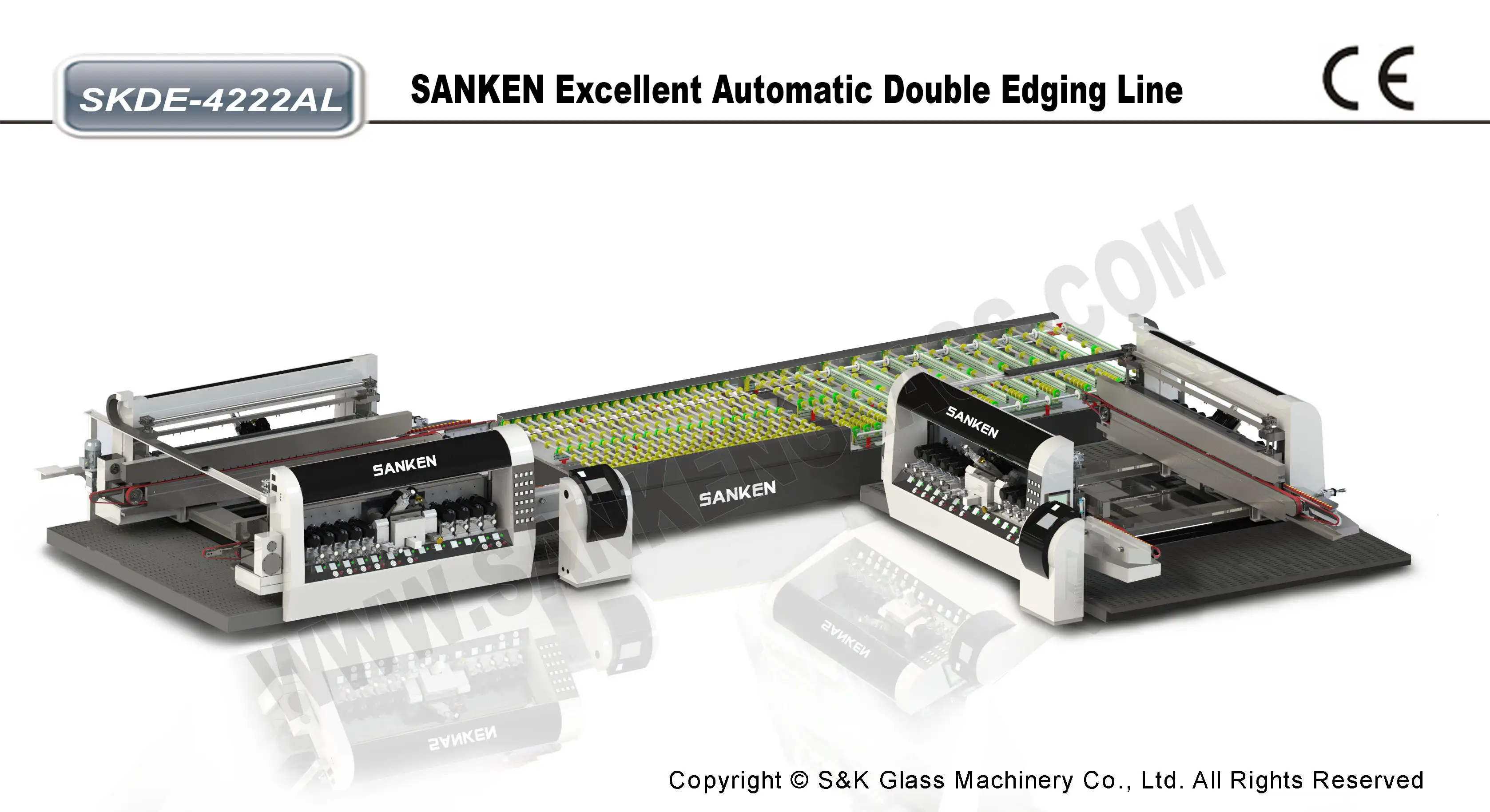
SANKEN Glass Straight Line Double Edging Line
SANKEN Glass Straight Line Double Edging Line combines two double edging machines with an automatic transit table to process all four edges of rectangular flat glass in a continuous production flow. The first double edger processes two parallel edges, after which the transit system changes the glass direction and transfers it to the second double edger for the remaining two edges.
The SKDE line series is available in different processing sizes for architectural, furniture, appliance, solar and other flat-glass applications. Line configuration can be selected according to maximum glass dimensions, edge-processing requirements, production capacity and factory layout.
Glass Straight Line Double Edging Line
The SANKEN SKDE-AL series Glass Straight Line Double Edging Line combines two double edging machines with an automatic transit table for continuous four-side processing of rectangular flat glass.
The first double edger processes one pair of parallel glass edges. The glass is then transferred and redirected by the automatic transit table before entering the second double edger, where the remaining two edges are processed. This coordinated layout allows rough grinding, chamfering, fine grinding and polishing of all four sides within one production flow.
The SKDE-AL series is available in ten catalogue configurations with maximum processing sizes ranging from 2000 × 2000 mm to 6000 × 3000 mm, allowing the line to be selected according to glass size, required edge-processing capacity and factory layout.
SKDE-AL Series Glass Straight Line Double Edging Line
Production Line Components
First Double Edging Machine
The first double edger processes the first pair of parallel glass edges. Depending on the selected configuration, the grinding stations perform rough grinding, chamfering, fine grinding and polishing along both edges during glass transfer through the machine.
Automatic Transit Table
The automatic transit table connects the two double edging machines. It transfers and redirects the glass after the first two edges have been processed so that the remaining pair of edges can enter the second machine.
Second Double Edging Machine
The second double edger processes the remaining two parallel edges, completing four-side edge processing of the rectangular glass sheet.
Working Sequence
Rectangular glass enters the first double edging machine for processing of two opposite edges. The transit table then transfers and redirects the glass before it enters the second double edger. The remaining two edges are processed in the second machine to complete four-side grinding and polishing.
Key Functions
Continuous Four-Side Processing
Two double edging machines work as one coordinated line to process all four sides of rectangular glass without manually transferring the sheet between separate edging operations.
Grinding, Chamfering and Polishing
The edging process can include rough grinding, chamfering, fine grinding and polishing according to the selected machine configuration and required edge finish.
Automatic Glass Transfer
The transit table coordinates glass movement between the first and second double edgers, reducing repeated manual handling between the two edge-processing stages.
Double Linear Guide and Ball Screw Structure
The edging equipment uses a transmission structure with double linear guides and double ball screws to support stable movement and positioning during processing.
Multiple Processing Sizes
Ten SKDE-AL configurations cover different glass dimensions, from 2000 × 2000 mm up to 6000 × 3000 mm, allowing factories to select a line size according to their regular production range.
Factory Layout Planning
The line arrangement can be reviewed according to production flow and available factory space. Straight-line and L-shaped arrangements can be considered during project layout planning.
Production Line Details
Machine views and structural details of SANKEN glass straight line double edging equipment.
Technical Specifications
The SKDE-AL series is available in ten processing-size configurations. All listed models support 3–25 mm glass and an adjustable processing speed of 0–18 m/min.
| Model | Max. Processing Size | Min. Processing Size | Glass Thickness | Processing Speed | Total Power | Machine Size |
|---|---|---|---|---|---|---|
| SKDE-2020AL | 2000 × 2000 mm | 300 × 300 mm | 3–25 mm | 0–18 m/min | 136 kW | 11273 × 7800 × 1800 mm |
| SKDE-2520AL | 2500 × 2500 mm | 300 × 300 mm | 3–25 mm | 0–18 m/min | 136 kW | 11773 × 8000 × 1800 mm |
| SKDE-4222AL | 4200 × 2500 mm | 300 × 300 mm | 3–25 mm | 0–18 m/min | 150 kW | 13873 × 8592 × 1800 mm |
| SKDE-4522AL | 4500 × 2500 mm | 300 × 300 mm | 3–25 mm | 0–18 m/min | 150 kW | 13973 × 8392 × 1800 mm |
| SKDE-5022AL | 5000 × 2500 mm | 300 × 300 mm | 3–25 mm | 0–18 m/min | 150 kW | 14473 × 8392 × 1800 mm |
| SKDE-4024AL | 4000 × 2500 mm | 300 × 300 mm | 3–25 mm | 0–18 m/min | 164 kW | 13673 × 8592 × 1800 mm |
| SKDE-4524AL | 4500 × 2500 mm | 300 × 300 mm | 3–25 mm | 0–18 m/min | 164 kW | 14173 × 8592 × 1800 mm |
| SKDE-5024AL | 5000 × 2500 mm | 300 × 300 mm | 3–25 mm | 0–18 m/min | 164 kW | 14673 × 8592 × 1800 mm |
| SKDE-6022AL | 6000 × 2500 mm | 300 × 300 mm | 3–25 mm | 0–18 m/min | 150 kW | 15473 × 8392 × 1800 mm |
| SKDE-6024AL | 6000 × 3000 mm | 300 × 300 mm | 3–25 mm | 0–18 m/min | 164 kW | 15673 × 8592 × 1800 mm |
Choosing the Right SKDE Double Edging Line
Model selection should begin with the maximum glass dimensions required in regular production. The SKDE-AL range provides several table-width and line-length options so that the equipment size can be matched to the actual glass products being processed.
Compact Processing Sizes
SKDE-2020AL and SKDE-2520AL are intended for factories where the regular maximum glass size is within 2000 × 2000 mm or 2500 × 2500 mm. These configurations use 136 kW total power and have the smallest overall footprint in the series.
4000–5000 mm Processing Length
SKDE-4222AL, SKDE-4522AL and SKDE-5022AL provide maximum processing lengths from 4200 to 5000 mm with a 2500 mm maximum width and 150 kW total power.
SKDE-4024AL, SKDE-4524AL and SKDE-5024AL provide corresponding processing lengths with 164 kW total power for alternative edging configurations.
Large-Format Glass Processing
SKDE-6022AL supports glass up to 6000 × 2500 mm, while SKDE-6024AL provides the largest catalogue processing size at 6000 × 3000 mm. These configurations are intended for production involving large-format rectangular glass.
Before final model selection, maximum and minimum glass dimensions, required edge finish, expected output and available factory space should be reviewed together.
Double Edging Machine vs. Double Edging Line
A standalone glass double edging machine processes two parallel edges of rectangular glass in one pass. A glass double edging line combines two double edgers with an automatic transit table so that both pairs of opposite edges can be processed automatically.
Double Edging Line = First Two Edges → Automatic Transfer → Remaining Two Edges
For factories requiring continuous four-side grinding and polishing, the double edging line provides an integrated workflow. Where only two-edge processing is required, a standalone double edging machine may be the more appropriate configuration.
Applications
The SKDE-AL series is suitable for four-side edge processing of rectangular architectural glass, home appliance glass, furniture glass, solar glass, bathroom glass and other flat-glass products.
The production line is particularly suitable for batch processing where automatic transfer between opposite glass edges and continuous grinding and polishing are required.
Frequently Asked Questions
What is a glass straight line double edging line?
It is a production line that combines two double edging machines with an automatic transit table to process all four edges of rectangular flat glass.
How are all four glass edges processed automatically?
The first double edger processes two opposite edges. The automatic transit table then redirects and transfers the glass to the second double edger, which processes the remaining pair of edges.
What glass thickness can the SKDE-AL series process?
The listed SKDE-AL configurations are specified for glass thicknesses from 3 to 25 mm.
What is the processing speed?
The listed SKDE-AL models have an adjustable processing speed of 0–18 m/min.
What is the largest available processing size?
SKDE-6024AL provides the largest size in the listed range, with a maximum processing size of 6000 × 3000 mm.
What is the difference between a double edging machine and a double edging line?
A standalone double edging machine processes two parallel glass edges. A double edging line uses two double edgers and an automatic transit system to complete all four edges in one coordinated workflow.
Can the line layout be planned according to factory space?
Yes. The equipment arrangement can be reviewed according to factory dimensions, material flow and connection requirements before the final layout is confirmed.
How should I choose an SKDE-AL model?
Provide the maximum and minimum glass dimensions, thickness range, required edge finish, expected production capacity and factory layout. These details can be used to determine the appropriate SKDE-AL configuration.
Equipment Selection and Line Planning
For production-line selection, provide your maximum and minimum glass dimensions, thickness range, required edge finish, expected production capacity and factory floor plan. SANKEN can review the suitable SKDE-AL model and line arrangement for the planned glass edge-processing workflow.
SANKEN Glass Machinery is a Guangzhou-based manufacturer and international supplier of glass-processing machinery and complete production-line solutions.
Contact Us
Contact: Dalia Qiu
Tel: +86 15994813914
Landline: +86-20-82347228
Email: sales@sankenglass.com
WhatsApp: +86 15994813914
ADD: No.2, Xinghai Road, Lanhe, Nansha District, Guangzhou City, China. P.C 511480