Please fill out the form below to request a quote or to request more information about us. please be as detailed as possible in your message, and we will get back to you as soon as possible with a response. we're ready to start working on your new project, contact us now to get started.
Exporting glass-processing machinery since 2002, with international project support from planning to installation and training.
Waterjet vs. CNC Glass Machinery for Complex Shapes & Edges
2026-09-11
SANKEN
2
The glass industry has seen significant advancements in technology, leading to more precise and complex cutting solutions. Whether you're working with architectural glass, curved shower doors, or intricate decorative pieces, choosing the right equipment is crucial. This article will explore the differences between CNC glass machinery and waterjet cutting technology, especially in the context of complex shapes and edges, and provide insights on which technology is better suited for specific applications.
Overview of CNC Glass Machinery
Advantages and Uses of CNC Glass Machinery
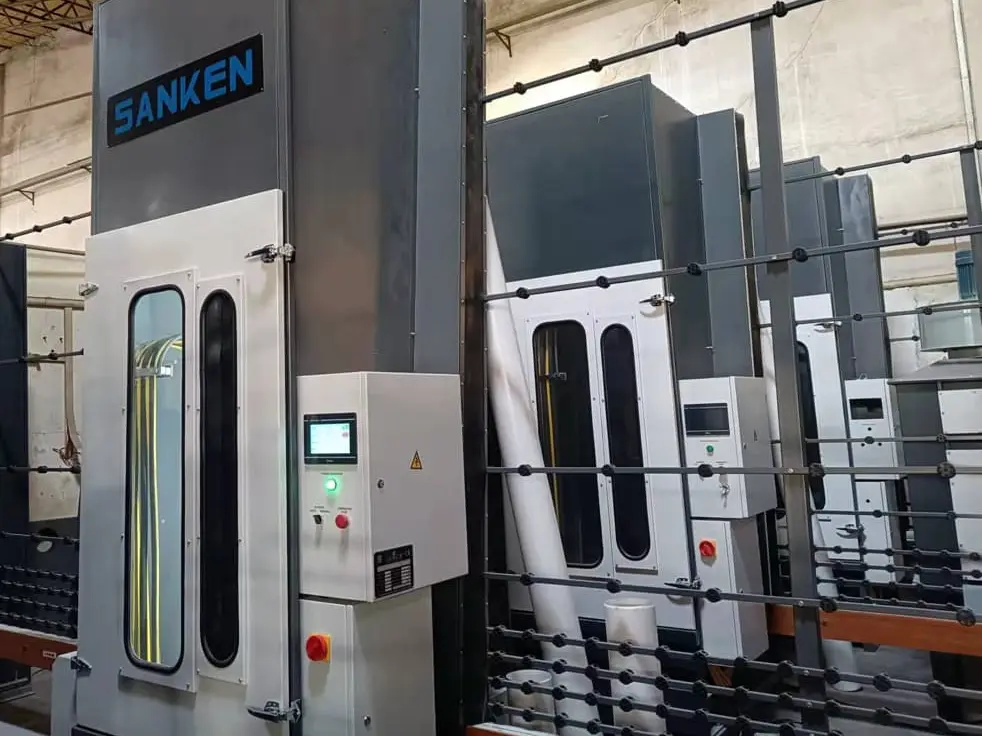
CNC (Computer Numerical Control) glass machinery offers unparalleled precision and versatility. Unlike manual glass cutting methods, CNC machines can cut and engrave glass with extremely fine detail and consistency.
Benefits of CNC Glass Machinery
- Precision: CNC machines can achieve very fine tolerances, making them ideal for high-precision applications.
- Repeatability: CNC machines can consistently produce identical cuts, ensuring uniformity in large-scale production.
- Versatility: CNC machines can handle a wide range of cutting operations, from simple straight cuts to complex curved shapes.
- Speed: CNC machines are highly efficient, often cutting through glass at a faster rate compared to manual or basic machinery.
Overview of Waterjet Cutting Technology
Advantages and Uses of Waterjet Cutting Technology
Waterjet cutting is a method that uses high-pressure water or water mixed with abrasive particles to cut through materials, including glass. This technology has gained popularity due to its non-contact nature and flexibility.
Benefits of Waterjet Cutting
- Non-Contact Cutting: Waterjet cutting is non-contact, reducing the risk of damage to the glass caused by blades or mechanical cutting tools.
- Material Versatility: Waterjet cutting can handle a wide range of materials, including irregular and complex shapes, making it ideal for intricate designs.
- Flexibility: Waterjets can be used to create complex shapes and curved edges with ease.
- No Heat Affected Zone (HAZ): Unlike some cutting methods, waterjet cutting does not generate heat, reducing the risk of thermal damage.
Comparison of CNC and Waterjet Cutting for Complex Shapes & Edges
Advantages of CNC for Complex Shapes & Edges
- Fine Detail: CNC machines can achieve very fine details and exact dimensions, particularly useful for intricate designs.
- Consistent Accuracy: CNC machines offer high consistency, ensuring that each cut is precise and accurate.
- Multiple Operations: CNC machines can perform multiple operations in a single setup, reducing setup time and increasing efficiency.
Advantages of Waterjet for Complex Shapes & Edges
- Versatile Cutting: Waterjet cutting can handle complex shapes and curved edges with ease, making it ideal for intricate designs.
- No Heat Affected Zone: Waterjet cutting is a cold cutting process, preserving the integrity of the glass.
- Non-Contact Cutting: Waterjets do not exert physical contact on the glass, reducing the risk of damage.
Table: Comparison of CNC and Waterjet Cutting for Complex Shapes & Edges
| Aspect | CNC Glass Machinery | Waterjet Cutting Technology |
|---|---|---|
| Precision | Very high precision, capable of fine detail | High precision, although slightly less than CNC |
| Complexity | Excellent for intricate designs and multi-step operations | Excellent for complex and curved shapes |
| Material Variety | Best for smooth, uniform materials | Excellent for a wide range of materials, including irregular shapes |
| Heat Affected Zone (HAZ) | May generate heat, requiring cooling | No heat generation, preserving glass integrity |
| Non-Contact Cutting | Uses mechanical contact, risking minor damage | No mechanical contact, minimizing damage |
| Setup Time | Longer setup time due to programming | Faster setup due to flexibility |
| Maintenance | Requires regular maintenance and tool replacements | Requires regular servicing but less mechanical parts to maintain |
Precision and Complexity
Precision Comparison
- CNC Precision: CNC machines can achieve very fine tolerances, making them ideal for high-precision applications.
- Waterjet Precision: Waterjet cutting is highly precise, although slightly less than CNC, especially for fine details.
Complexity Comparison
- CNC Complexity: CNC machines excel in handling intricate designs and multi-step operations.
- Waterjet Complexity: Waterjets can handle complex shapes and curved edges with ease, making them ideal for intricate designs.
Cost and Maintenance
Cost Effectiveness
- CNC Cost: CNC machines may have a higher initial investment and ongoing maintenance costs, but offer long-term savings due to increased efficiency and productivity.
- Waterjet Cost: Waterjet machines typically have a lower initial investment and running costs, making them more cost-effective for smaller operations.
Maintenance Requirements
- CNC Maintenance: CNC machines require regular maintenance and tool replacements to ensure optimal performance.
- Waterjet Maintenance: Waterjet machines require regular servicing but have fewer mechanical parts to maintain, reducing downtime.
Material and Applications
Material Suitability
- CNC Material Suitability: Best for smooth, uniform materials like architectural glass, where consistent cuts are necessary.
- Waterjet Material Suitability: Ideal for a wide range of materials, including irregular shapes, ensuring flexibility in design.
Application Suitability
- CNC Application Suitability: Ideal for architectural glass, decorative panels, and high-precision production where long-term consistency is essential.
- Waterjet Application Suitability: Best for intricate designs, curved edges, and applications requiring a wide range of material varieties.
Conclusion
Final Comparison and Recommendation
In conclusion, both CNC glass machinery and waterjet cutting technology offer unique advantages for complex shapes and edges.
- CNC Glass Machinery is ideal for high-precision applications, intricate designs, and consistent cuts, making it the preferred choice for large-scale production and architectural glass projects.
- Waterjet Cutting Technology is ideal for complex shapes, curved edges, and a wide range of materials, making it the best choice for intricate designs and applications requiring flexibility and material variety.
At SANKEN, our CNC glass machinery is designed to provide the highest level of precision, consistency, and efficiency. Whether you're working on architectural glass, curved shower doors, or intricate decorative pieces, our CNC glass machinery is the right choice for achieving high-quality and precise results.
Table of Contents
GET IN TOUCH WITH Us
recommended articles
SANKEN Glass Machinery is a Guangzhou-based manufacturer and international supplier of glass-processing machinery and complete production-line solutions.
Useful Links
Products
Contact Us
Contact: Dalia Qiu
Tel: +86 15994813914
Landline: +86-20-82347228
Email: sales@sankenglass.com
WhatsApp: +86 15994813914
ADD: No.2, Xinghai Road, Lanhe, Nansha District, Guangzhou City, China. P.C 511480
Copyright © 2026 Guangzhou Sanken Glass Machinery Co., Ltd.| Sitemap